The month that convinces most people to look at franchise accounting software goes like this. Every location closed its own books in its own file. Someone requested exports, chased the three that were late, pasted them into a consolidation workbook, corrected two accounts that had been renamed locally, and produced a roll-up eleven working days after month end. By then operations had already made the decisions the numbers were meant to inform.
The instinct is to treat that as a discipline problem and push the locations harder. It is not. It is a structural problem: forty separate ledgers cannot consolidate themselves, and no amount of chasing changes that. What changes it is one ledger that holds every location as its own entity, with a shared chart of accounts and a consolidation that runs as a report rather than as a project.
Key Takeaways
- Consolidation stops being an assembly job. Locations post into one system with one chart of accounts, and the roll-up is a report you run rather than a workbook you build.
- The biggest design decision is entity versus dimension: a location that files its own tax return needs to be an entity, and a location that only needs separate reporting can be a dimension.
- Franchisors and multi-unit operators are buying different things. Franchisors need fee calculation and franchisee reporting; operators need location P&L and same-store comparison.
- Standardising the chart of accounts comes before everything else, and it is a negotiation with location bookkeepers rather than a technical task.
- Royalty and marketing fund calculations belong in a documented rule, not in a spreadsheet only one person can reproduce.
- Opening balances across many entities are the most laborious part of cutover. Budget real time to reconcile them location by location.
Screenshots throughout are Sage Intacct product material. The figures shown in them are Sage’s demonstration data, not Lucentive client results.
What franchise accounting software has to do that a single-entity ledger cannot
It has to hold many legal entities in one system, share a chart of accounts across all of them, post intercompany transactions without manual journals on both sides, and consolidate on demand. That combination is what removes the export-and-paste cycle, because every location’s activity is already in the same ledger the moment it is entered.
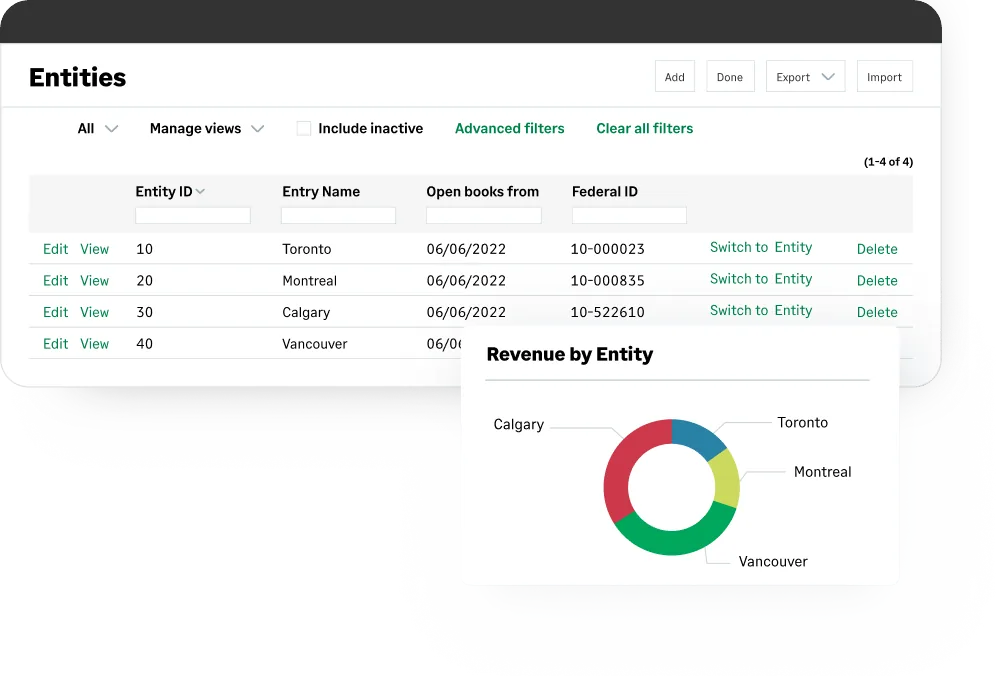
The entity list is the shape of the whole build. Each location has an identifier, a name, its own open-books date and its own federal tax identifier, and a user with the right permissions can switch into any one of them or step up to the consolidated view. That switching is the day-to-day mechanic that a folder of separate company files can never offer: the same person can close location twelve and location thirty without changing systems, and the revenue-by-entity comparison alongside it is live rather than assembled.
Two things follow. Adding a location becomes configuration rather than a new implementation, which matters when you open several in a year. And eliminations, intercompany balances and management fees are handled inside the system rather than as adjusting journals somebody remembers to reverse. The wider case is set out in our piece on consolidating and automating finances for multi-entity organisations.
Franchisor or multi-unit operator: two different builds
These get discussed as one market and they are not. A franchisor collects fees from businesses it does not own. A multi-unit operator owns the locations and consolidates them. Some organisations are both. The distinction decides what you configure first, so establish it in the first conversation rather than the third.
If you are the franchisor
Your revenue is royalties, marketing fund contributions and initial franchise fees, and all three depend on data reported to you by people outside your ledger. The build centres on how that reported revenue arrives, how the fee is calculated from it, how the invoice is raised and collected, and how the marketing fund is tracked separately because its use is restricted. Initial franchise fees also raise a revenue recognition question your auditor should settle before configuration starts.
If you own the locations
Your problem is comparability. You need a profit and loss statement per location, on the same account structure, fast enough to act on, plus the ability to compare like with like across sites of different ages and sizes. The build centres on entity structure, a standardised chart of accounts, and a dimension design that supports the comparisons you actually make. Operators in food and lodging will find sector specifics in our guide to hospitality accounting software; grouped healthcare practices face a close cousin of the same problem, covered in our piece on accounting software for DSOs.
Efficiently managing complex financial structures: entity or dimension
This is the decision that shapes everything after it, and the rule is simpler than the debate around it. If a location has its own legal identity and files its own return, it is an entity. If it exists only so you can report on it separately, it is a dimension value.
Making everything an entity because it feels safer is the common and expensive mistake. Entities carry overhead. Each has its own books to open and close, its own balance sheet, its own reconciliations. Dimensions carry almost none: a location dimension gives you the same reporting split with none of the closing work. A group with twelve legal entities and ninety trading sites should have twelve entities and a location dimension with ninety values, not one hundred and two entities.
Get the dimension list right at the same time. Location is obvious. Most franchise groups also want department or function, and many want a category that distinguishes company-owned from franchised sites so the two can be reported separately without maintaining two report sets. Retrofitting a dimension after a year of postings means re-tagging history, which is why dimension design belongs in the first weeks of the project.
Shared services need a decision too. Where head office pays for insurance, marketing or a regional manager on behalf of locations, agree how that cost is allocated and whether the allocation posts or stays in reporting. Posted allocations are auditable and slower; reporting allocations are flexible and less defensible. Choose deliberately.
See your business information your way: location P&L and same-store comparison
Once locations sit in one ledger on one account structure, the reporting most operators actually want becomes straightforward: a P&L per site, the same P&L for every site side by side, a rank of sites by contribution, and a comparison against the same period last year. None of that requires anything exotic.

It requires that every site codes its costs the same way. That last condition is where the work is. Same-store comparison breaks when one location books delivery fees in cost of sales and another books them in operating expenses. It breaks when a site that opened in March is compared to a full year without anyone flagging it. It breaks when three locations use an account called “supplies” for three different things. Standardising the chart of accounts is not a technical migration step; it is a series of conversations with location bookkeepers about which of their local conventions survive.
Build few reports first and let usage tell you what to add. A location P&L, a consolidated P&L with locations as columns, and a variance report against budget or prior year covers most weekly use.
Automating workflows across locations with a cloud system
Cloud matters here for a practical reason, not an architectural one: locations are in different places and so are the people who approve their spending. When the ledger is hosted, a district manager approves an invoice from a phone in a car park, and nobody maintains a remote desktop link into a head office server.

The automation that pays back fastest is accounts payable. Invoices arriving for many sites, coded by location, routed for approval by amount and by who runs that site, then paid centrally, removes a great deal of paper handling and gives head office visibility of committed spend before the bill is due. Our guide to accounts payable automation covers how those approval chains are built.
Bank feeds come next, particularly for groups with many accounts. Beyond that, be sceptical of automating a process you have not standardised. Automating forty versions of the same approval preserves forty versions.
Where franchise implementations get stuck
Most of the difficulty is organisational rather than technical, and it concentrates in a few predictable places. None of it is solved by which system you buy; each item below is a decision someone with authority has to make. All of them are cheaper to face in week two than in the week before go-live.
Forty charts of accounts and no agreement
Every location has evolved its own accounts and every bookkeeper has a reason for theirs. Standardising means somebody with authority decides what the group chart is and what maps into it. That needs a sponsor senior enough to overrule a long-serving bookkeeper, and it has to happen before migration rather than during it.
The royalty calculation nobody can reproduce
Franchisors frequently discover that fee calculation includes adjustments applied by one person from memory: a grace period for new units, a negotiated rate for an early franchisee, a deduction agreed verbally years ago. Every one of those has to be written down and confirmed as still valid before it can become a rule.
Opening balances, entity by entity
Migrating balances for many entities is the most laborious part of cutover. Each entity’s opening trial balance has to reconcile to what the old system said, and the reconciliations have to be evidenced for the auditor. Sequence it, staff it, and do not go live in your busiest trading month.
Location staff who have never used a ledger like this
People who have spent a decade in a simple bookkeeping product will find a dimensional system unfamiliar, and the first weeks generate real frustration. Train by role rather than by module, appoint one confident user per region as first-line help, and expect adoption to lag configuration by a month or two.
Evaluating from the datasheet
The page this post replaces closed with a datasheet, an e-book, a white paper and an analyst report behind a form. Those describe capability, which is broadly the same across every mid-market system you will shortlist. They cannot tell you whether your locations will agree on a chart of accounts, and that is what determines whether the project delivers.
The franchise brand and the review badge beside them read the same way. A well-known franchisor on the platform tells you the structure can be made to work at scale, and a peer-review badge tells you owners rate the product. Both are true. Neither is about your project, which will turn on whether a sponsor can get forty bookkeepers onto one account structure.


What changes after go-live
The consolidated close arrives earlier and, more usefully, arrives without a fortnight of assembly behind it. Location results are visible as they post rather than after they are collected, which changes the conversation from explaining last month to acting on this one.
[DATA: Lucentive’s measured reduction in consolidated close time across recent multi-location implementations — Rich to confirm]
The second change is comparability. When every site reports on the same structure, underperformance shows up early and as a number rather than an impression. That is uncomfortable for a while, and it is the main reason the system pays for itself.
Hear the trade-offs plainly. Locations lose autonomy over how they code things, and some will experience that as a loss of judgement rather than a gain in comparability. Head office takes on more central work, particularly in payables. And someone must own the master data, because an unowned chart of accounts drifts apart within a year.
Summary
Franchise accounting software is worth buying when your consolidation is manual and your location comparisons are unreliable. The mechanism is one ledger, many entities, one chart of accounts and a dimension structure designed around the comparisons you actually make. The sequence that works is entity structure first, chart of accounts second, dimensions third, then reporting, then automation.
If you are evaluating now, the most useful preparation costs nothing. Take last month’s roll-up, mark every figure typed or pasted rather than posted, and list every account that means something different at different locations. Our consultants will map each item to how it would be produced after implementation, and say which parts need an internal decision before any software helps. You can start that conversation with our team whenever the lists are ready.
Frequently Asked Questions
What is franchise accounting?
Franchise accounting covers two related things. For a franchisor it is the accounting for franchise fees, royalties and marketing fund contributions, including when initial fees may be recognised. For a multi-unit operator it is consolidating many locations into one set of statements while still reporting each separately. Most software conversations are about the second, so establish which you need early.
Do we need a separate legal entity for every location?
Only where the location genuinely has one. The test is whether it files its own return or has its own legal identity. If a site exists separately only for reporting, it should be a dimension value rather than an entity, because entities carry closing and reconciliation work that dimensions do not. Most groups end up with fewer entities and more dimension values than they expect.
Can franchisees keep their own accounting system?
Usually yes, and often they must, because they are independent businesses. The franchisor’s build then focuses on how reported figures arrive, how fees are calculated from them and how disputes are handled, rather than on consolidating franchisee ledgers. Some franchisors offer a standard system to franchisees for data consistency, which is a commercial decision carrying real support obligations.
How are royalty and marketing fund fees handled?
The reported sales figure drives a calculated fee, which becomes an invoice to the franchisee and revenue or restricted fund income to you. The implementation work is in the rules rather than the mechanics: tiered rates, grace periods for new units, minimum fees and legacy agreements all have to be documented and confirmed as current. Marketing funds are tracked separately because the agreement restricts their use.
Is franchise management software the same thing?
No. Franchise management systems handle the operational side, such as franchisee onboarding, field audits, training records and unit performance tracking. Franchise accounting software is the financial ledger underneath. They frequently integrate, with the management system supplying reported sales that drive fee calculation, but neither replaces the other and each has its own implementation.
How long does a multi-location rollout take?
It depends far more on how many entities you have, how different their charts of accounts are, and how much history you migrate than on the number of locations. Groups already sharing an account structure move quickly. Groups where every site evolved its own conventions spend most of the project on standardisation. Phasing by region rather than going live everywhere at once is common and usually sensible.