Most organisations that come to us about healthcare accounting software are not shopping for a general ledger. They are trying to end the monthly scramble: four clinics and a management company each close on their own schedule, three trial balances get exported into a workbook, the eliminations are keyed by hand, and the consolidated numbers reach the board about the time they stop being useful.
Meanwhile the CFO wants margin by site, the grant manager wants cost by funding source, and the compliance officer wants to know who can see what. A ledger never structured for those questions cannot answer them, which is why the product choice matters far less than four early decisions: where entity boundaries fall, which dimensions get captured at entry, where the practice management system stops and the ledger starts, and who owns HIPAA.
Lucentive implements Sage Intacct for medical groups, community health centres and senior care operators. Our Sage Intacct healthcare software solutions page covers what we do. This is the implementer’s account of what happens inside an engagement.
Key Takeaways
- HIPAA obligations stay with you. A vendor can sign a Business Associate Agreement and hold security attestations while your permissions, reports and interfaces remain non-compliant.
- The cheapest way to cut HIPAA scope in finance is to keep protected health information out of the ledger and post summarised revenue by site, payor and service line.
- Not every clinic should be a legal entity. Entities carry their own ledger, close and intercompany traffic. Sites, programmes and funding sources are dimensions, which cost nothing to report by.
- Per-visit and per-encounter metrics need volume statistics inside the financial system. Plan that feed during design or cost per encounter stays a spreadsheet exercise.
- For an FQHC, the UDS and single-audit calendar should drive the chart of accounts and the cutover date. Retrofitting for them afterwards costs far more.
Screenshots throughout are Sage Intacct product material. The figures shown in them are Sage’s demonstration data, not Lucentive client results.
What healthcare accounting software has to do that a general ledger does not
Healthcare accounting software is a financial system built to report by the axes a healthcare organisation is managed by: site, provider, payor, programme, funding source and service line. A general ledger tracks money by account. Healthcare finance needs it tracked by account and by six other things at once, with no spreadsheet in between.
That difference shows up in every question leadership asks. Payor mix is a revenue split. Cost per encounter is money divided by a volume figure. Provider productivity attributes revenue to someone who never appears on an invoice. A ledger that knows only accounts and periods answers none of these without an export.
The half teams underestimate is volume. Cost per visit needs visits. Sage Intacct holds these as statistical accounts and journal entries, alongside the financial ledger on the same dimensions and periods. If design never settles where those counts come from, the per-unit metrics you bought the system for stay in a workbook.
What HIPAA actually requires of you, and what Sage Intacct is responsible for
HIPAA obligations sit with you, the covered entity. A vendor becomes a business associate only for the protected health information it handles, and only under an executed Business Associate Agreement. Sage states publicly that it will sign one with eligible customers and that its safeguards have been independently assessed against HIPAA and HITECH. Neither makes your configuration compliant.
That distinction is where implementations get into trouble. A vendor attestation covers the platform the vendor controls. It says nothing about which of your staff can open a report, whether your interface user is over-permissioned, whether a scheduled report emails patient-identifiable detail, or whether your Security Rule risk analysis was updated.
The highest-leverage move is to shrink the problem rather than manage it. In most implementations the ledger needs no protected health information at all. The practice management system stays the record for patient detail, and what crosses into finance is a summarised journal of charges, adjustments, payments and refunds by site, payor and service line.

Where patient-level detail genuinely has to land in finance, usually in self-pay receivables, the system is in scope and you configure accordingly: permissions restricted by entity and dimension, controlled report distribution, a named cadence for access reviews, and the audit trail switched on and read. The screen above records what an auditor and a breach investigation both ask for: what changed, who changed it, and whether the change came through the interface or the API.
That API column matters. Your integration user moves more data than any human account, so it needs the narrowest permissions and its own agreement chain: a BAA with your software vendor covers nothing between the EMR and the ledger. More in Sage Intacct HIPAA compliance and beyond and integrating your financial system with an electronic medical record.
Draw your entity boundaries before you configure anything
Not every clinic needs to be a legal entity. An entity carries its own ledger, close and intercompany traffic. Sites, departments, programmes and funding sources are dimensions, and dimensions are free to report by. Most multi-site groups arrive wanting an entity per location and leave with fewer.
Something deserves to be an entity if it files its own tax return, produces its own audited statements, holds its own bank relationship, or receives restricted funding requiring separate books. Everything else is a reporting question, and reporting questions are answered by dimensions.
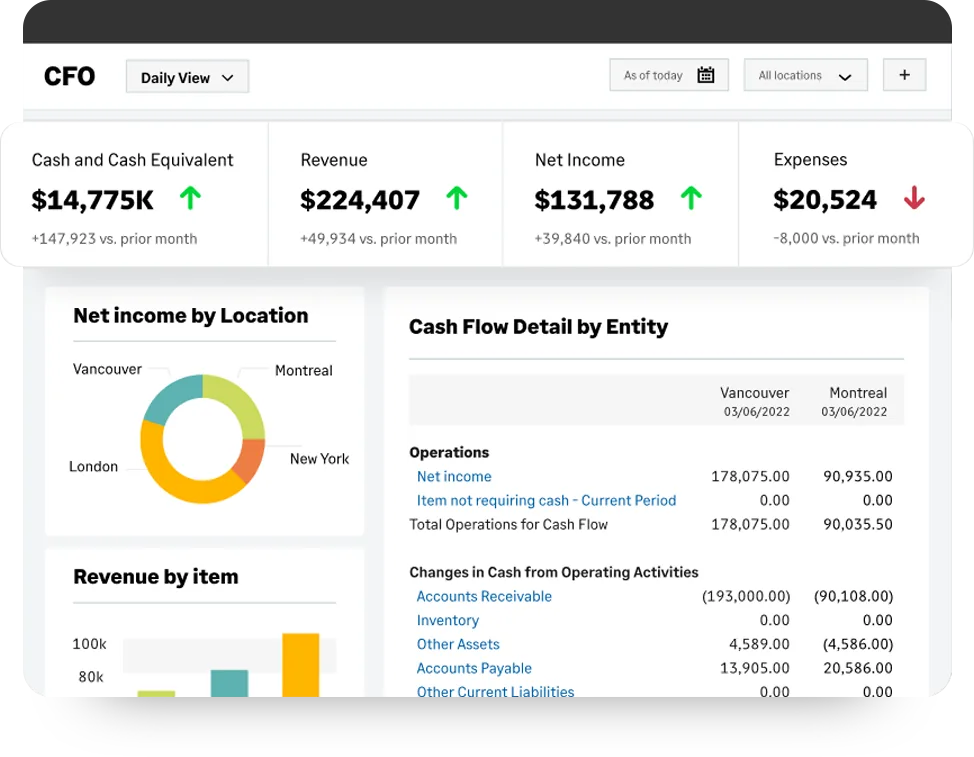
Once boundaries are set the mechanics are good. A shared chart of accounts gives one definition of an expense line everywhere, and consolidation runs continuously rather than as a month-end event, so a group view exists on any day you want one, as in the entity-by-entity cash flow detail above. Intercompany posts both sides automatically, which matters in the management company structure most medical groups use: a manual management fee allocation is the largest source of late-close disputes.
Write that allocation policy before configuration: the basis, the timing and the approval. Configuration automates any policy you can state clearly. More in consolidating and automating finances for multi-entity organizations and Sage Intacct dimensions.
Multi-entity healthcare reporting and the questions leaders actually ask
Multi-entity healthcare reporting means answering a question once at group level and having every site, programme and payor split fall out of the same query. It works when dimensions were captured at entry and statistics fed alongside them. It fails when either half is missing, and no dashboard recovers from that afterwards.
The questions are predictable. Margin by site. Payor mix and how it is drifting. Revenue per visit and per clinician. Cost per encounter by service line. Operating expense by functional category.
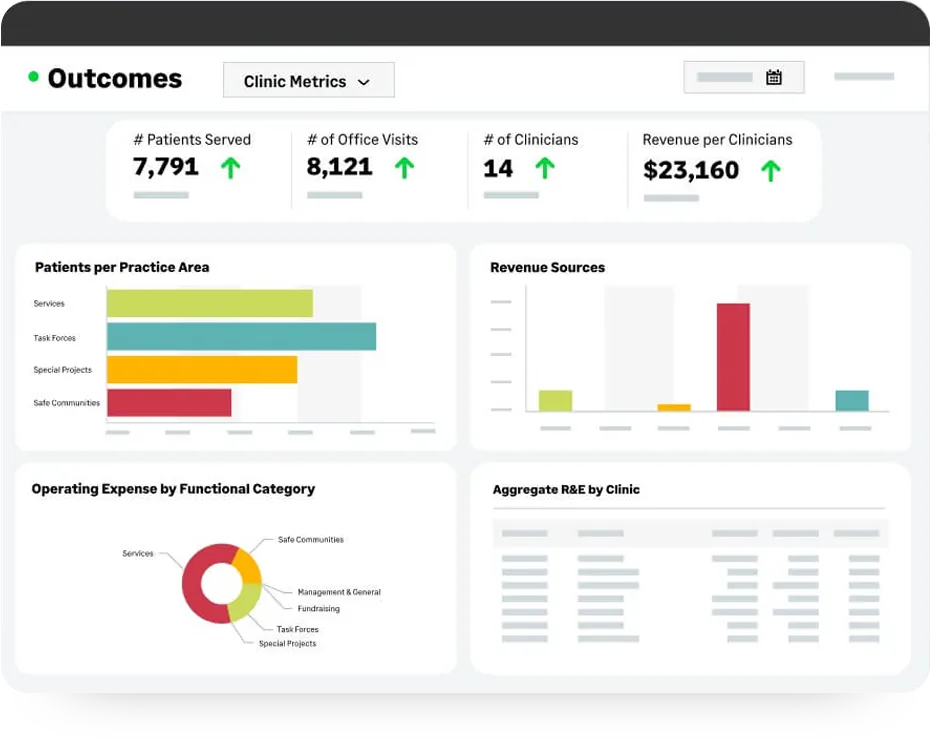
Look at what that screen needs underneath it. Patients served and office visits are statistics, not money. Revenue per clinician needs a provider dimension on revenue arriving in summary from the practice management system. Operating expense by functional category needs a functional dimension on every expense transaction, including the ones keyed by a clerk who has never seen that report. That is a process problem disguised as a reporting problem.
Build few dashboards first: a CFO view, a site operations view and one programme view. A quarter of real use teaches more than any design session. The approach is in our guide to Sage Intacct dashboards and reporting.
[DATA: Lucentive’s measured close-time reduction across multi-entity healthcare clients — Rich to confirm]
FQHC and community health: UDS, grants and funding-source reporting
An FQHC is a Federally Qualified Health Center: a community-based provider receiving HRSA Section 330 funding, required to serve patients regardless of ability to pay, to operate a sliding fee scale, and to report annually through the Uniform Data System. That obligation, more than the accounting, shapes the chart of accounts.
The design follows from what has to be reported. UDS wants cost and activity split by site and service type, so both are non-negotiable dimensions. Section 330 funds must stay distinguishable from patient service revenue and other grants, so funding source is a dimension rather than an account. Grant periods rarely align with the fiscal year, so the system reports on a grant calendar independently. Sliding fee discounts belong as contra-revenue, because the discount total is reported.
Two things catch teams out. Indirect cost allocation to grants needs a documented basis, configured once and reproducible on demand. And the single audit needs a schedule of expenditures of federal awards, a simple report if award is a dimension and a reconstruction if it is not. Where the organisation is also a 501(c)(3), nonprofit fund accounting requirements sit on top, and our FQHC accounting software page goes further.
[DATA: number of FQHC and community health centre implementations Lucentive has delivered — Rich to confirm]
What a healthcare implementation actually involves
A healthcare implementation is roughly one part software configuration and three parts decisions about structure, interfaces and process ownership. Configuration is the predictable part. Schedule risk lives in the practice management interface, the opening balances, and the availability of your own people.
Design comes before anything is switched on
Design produces the entity structure, the chart of accounts, the dimension list with a rule for who applies each one, and the statistics feed. Work backwards from the reports you must file and the questions leadership asked last year that took over an hour to answer. Almost every engagement shrinks the chart of accounts here, because teams coming off a flat ledger encoded site and department into account numbers.
The practice management interface is the long pole
Whatever your clinical system, the finance interface is usually a periodic summary journal keyed by site, payor and service line, reconciled to the source system’s revenue report. Decide the grain and the timing, and name the person who works the exception queue when a batch does not balance. Payroll needs the same attention, because its dimension coding changes on the payroll side.
Migration and cutover timing
You migrate opening balances by entity and open payables and receivables. You do not migrate dimensional history that never existed, which turns comparative reporting into a credibility problem by month two. Pick the date dimensional reporting begins and tell leadership that date. Avoid cutting over at fiscal year end or in the UDS window.
[DATA: Lucentive’s typical implementation timeline for a multi-site healthcare organisation — Rich to confirm]
[DATA: Lucentive’s software, implementation and support cost ranges for a healthcare group — Rich to confirm]
What decides whether it sticks is ownership after the consultants leave. Name the internal report owner during the project and train that person deeply. Resourcing context is in planning the costs, time and resources for an ERP implementation.
Sage 50 versus Sage Intacct, the alternatives, and how to read the badges
Sage sells several products and they are not variations on one theme. Sage 50 is desktop-oriented small-business accounting with a single ledger. Sage Intacct is a multi-entity cloud financial system with dimensional reporting and continuous consolidation. If you run more than one entity, that difference is the whole comparison.
The alternatives worth evaluating are NetSuite, Microsoft Dynamics 365 Business Central, and for very large hospital systems the enterprise suites bundled with revenue cycle. Staying on QuickBooks with a consolidation tool alongside is a real option for a two-entity group that is not growing; where teams outgrow it is covered in outgrowing QuickBooks as a healthcare provider.
Be equally clear about what this platform is not: not a practice management or clinical system, not a payroll engine, and without the inventory depth of a manufacturing ERP if you run a large pharmacy.

Sage Intacct carries reviewer badges of this kind from G2, and they are Sage’s badges rather than Lucentive’s. A reviewer badge says that users who left reviews were positive. It says nothing about whether your practice management interface will reconcile, or whether your dimension design supports UDS. Ask for references with your entity structure and funding mix, then ask what went wrong.
Summary
The product choice is the smallest decision in front of you. Draw entity boundaries around legal and audit reality rather than geography. Design dimensions backwards from UDS, the single audit and the questions your board asks. Keep protected health information out of the ledger unless there is a reason it belongs there, and where it does, treat permissions, report distribution and the agreement chain as deliverables with owners.
If you are evaluating now, bring your month-end pack and your last UDS or audit submission with everything assembled by hand marked up. Our consultants will map each item to how it would be produced after implementation and say which are configuration and which need process change. Start a conversation with our team.
Frequently Asked Questions
What is healthcare accounting?
Healthcare accounting is financial accounting shaped around how healthcare organisations are managed and regulated. It tracks revenue by payor and service line, separates grant and restricted funding from patient service revenue, and pairs financial data with volume statistics such as visits and patient days, so per-unit cost measures come from the ledger rather than a spreadsheet.
Is Sage Intacct HIPAA compliant?
The accurate framing is that it can be used inside a HIPAA-compliant environment. Sage states publicly that it will sign a Business Associate Agreement with eligible healthcare customers and that its safeguards have been independently assessed against HIPAA and HITECH. Compliance still depends on your configuration: permissions, report distribution, access reviews, documented risk analysis, and agreements with every middleware vendor.
What does FQHC mean in healthcare, and does it change the accounting?
FQHC stands for Federally Qualified Health Center, a community-based provider receiving HRSA Section 330 funding that must serve patients regardless of ability to pay and report annually through the Uniform Data System. Site, service line, funding source and award become required reporting dimensions, grant periods run independently of the fiscal year, and sliding fee discounts need their own visibility.
Sage 50 versus Sage Intacct, which do we need?
Sage 50 is single-ledger small-business accounting for one set of books. Sage Intacct is built for multiple entities, dimensional reporting and continuous consolidation. If you run one entity, one location and one funding source, Sage 50 may be adequate. As soon as you consolidate entities or report cost by site and funding source, the two are not competing for the same job.
Is a free hospital or medical accounting software download worth using?
For a single-provider practice with one bank account, entry-level or free bookkeeping tools can genuinely work. For anything multi-site they are a detour. They do not consolidate entities, do not report by funding source, lack the audit trail depth an auditor expects, and vendors in that category will not sign a Business Associate Agreement.
Can it connect to our EMR or practice management system?
Yes, and the design question matters more than the connector. The usual pattern is a periodic summary journal posting charges, adjustments, payments and refunds by site, payor and service line, reconciled back to the source system’s revenue report. Keeping the interface at summary grain holds patient-level detail out of the ledger and reduces HIPAA scope in finance.