Nonprofit accounting software gets chosen on a feature list and lived with on a reporting calendar. Your team can already produce the numbers. What takes the week is producing them four ways: once for the board, once in each grantor’s template, once for the auditor who wants functional expense shown separately, and again when somebody asks how much of the restricted balance is spendable.
That week does usually disappear, because of decisions made in the first month about how funds, grants and restrictions are structured rather than anything on a comparison chart. Teams that treat structure as a configuration detail rebuild it inside a year.
What follows is the implementer’s view: how fund accounting behaves once it stops being separate ledgers, how grants and restrictions get tracked, and what the FASB net asset classes oblige you to report. Our Sage Intacct nonprofit software solutions page covers the engagement itself. This one goes a level deeper.
Key Takeaways
- Fund accounting here is not a stack of separate ledgers. Funds, grants and programs are dimensions on one ledger, so a single transaction reports to a funder, a program manager and the board without being entered three times.
- Donor restriction is a reporting attribute, not a second set of books. Define the restriction and release rules during design. Retagging historical gifts after go-live is the most common avoidable rework.
- There are two FASB net asset classes now: with donor restrictions and without. Your account and dimension structure has to produce both, plus the functional expense analysis and the liquidity disclosure.
- Grant tracking works when the grant is a dimension carrying its own budget, period and restriction, so budget against actual by grant is a standing report rather than a monthly spreadsheet reconciliation.
- Board reporting stops being an assembly job once the board book is a saved report group on live data. It is usually the project’s first visible win.
Screenshots throughout are Sage Intacct product material. The figures shown in them are Sage’s demonstration data, not Lucentive client results.
What makes nonprofit accounting different from for-profit accounting
Nonprofit accounting measures accountability rather than ownership. With no shareholders, the reporting question stops being how much did we earn and becomes whether each gift was used the way its giver intended. That single shift is what produces fund accounting, donor restrictions, functional expense reporting and the net asset classes.
The mechanics follow. There is no owner’s equity, so the accounting equation ends in net assets. The income statement becomes a statement of activities and the balance sheet a statement of financial position. Two reports appear that no commercial business files: an expense analysis by function and natural class, and a liquidity note. All of it reconciles to your Form 990.
Nonprofit accounting is not conceptually harder than commercial accounting; it is wider. One transaction has to satisfy a board thinking in programs, a funder thinking in budget lines, and an auditor thinking in classes and disclosures. Software either captures enough at entry to serve all three, or your team reconstructs the difference by hand every month. Our summary of the key benefits of nonprofit accounting software makes the shorter case.
Faith-based and church accounting: where it differs again
Church finance offices run into a distinction that general nonprofit guidance treats as settled and congregations use loosely: designated giving is not the same as restricted giving. A gift given in response to a building appeal carries a donor restriction. Money your own elders or finance committee set aside out of general offering is a board designation, and it stays in net assets without donor restrictions however firmly it was minuted. Both get called the designated fund in conversation. In the ledger they have to be separable, which means the categories on your giving platform and your offering envelopes map one to one to the restriction attribute, and somebody owns that mapping every time a new appeal opens.
A building campaign is where the structure gets tested. The campaign is a multi-year restricted fund with pledges behind it, so you carry pledges receivable, a discount unwinding on the multi-year promises, and a release of restriction that follows qualifying construction spend rather than the depreciation that comes afterwards. Decide early whether loan payments on the finished building are a qualifying use of campaign gifts, because the wording of the original appeal decides it and reading that wording three years later is worse. Set the campaign up as its own dimension and pledged, received, spent and remaining stay reportable to the congregation at any point, instead of being rebuilt in a spreadsheet before each update.
Cash offerings need controls no grantor will ever ask you for. Loose cash has no external record until somebody counts it, so the count is the control: two unrelated counters who rotate, a count sheet both of them sign, and a real separation between whoever counts, whoever enters the batch and whoever reconciles the bank. Online and text giving moves that work rather than removing it. The platform’s batch total and the ledger deposit still have to agree, and a processing fee taken before the money lands is a reconciliation difference that has to be posted somewhere deliberate. A finance office of two people and a rota of volunteers cannot segregate every duty by headcount, so the honest answer is compensating controls, usually a treasurer or an elder outside the office who reviews the bank statements independently and initials them. Build the approval routing around the control you intend to run, not the one on the organization chart.
Reporting is the last difference. There is no grantor template and no funder deadline, so the discipline is self-imposed, and the audience is a board or an elder council of volunteers who serve fixed terms and arrive with mixed financial literacy. What they need is stable year over year: giving against budget by category, restricted and designated balances with a plain statement of what is actually spendable, months of cash, and campaign progress. Many churches also report to a denominational body and publish something to the congregation at an annual meeting, which is a third audience wanting a third level of detail. Design all three as saved report groups in the same phase, rather than treating the congregational summary as a document somebody writes afterwards. Our overview of cloud accounting software for faith-based organizations covers what that engagement looks like.
How fund accounting works in nonprofit accounting software
Fund accounting once meant a separate ledger for every fund and a manual roll-up. In a dimensional system it means one general ledger where each transaction carries tags for fund, grant, program, location and funding source, so a single posting reports to a grantor, a program director and the board without being entered again.
The design session that produces those tags is the highest-leverage hour in the project, and it works backwards. Lay out every report you owe somebody: each grantor template, the board book, the audit schedules. Every column has to trace to a dimension, and every dimension needs a rule about who applies it and when. Two things then fall out almost every time: the chart of accounts gets much smaller, and somebody discovers a question the current data cannot answer at all.
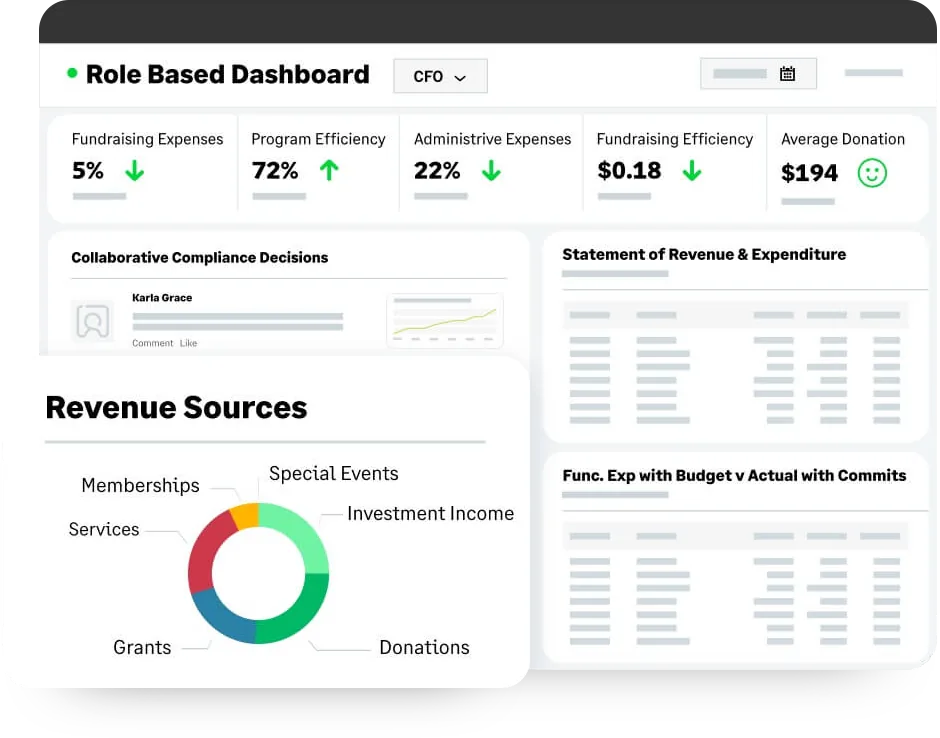
Interfund activity is the piece people underestimate. Due-to and due-from entries between funds, and the allocation runs that spread shared costs across programs, need designing as repeatable rules rather than month-end journals somebody remembers to post. Our page on how dimensions work is worth reading first.
Grant tracking, donor restrictions and releasing them correctly
A grant is tracked properly when it exists as its own dimension carrying a budget, a period and a restriction, rather than as a code buried in an account number. Budget against actual by grant then becomes a standing report instead of a monthly reconciliation somebody rebuilds from exports.
Most of the difficulty sits at the edges. Multi-year awards cross your fiscal years, so grant-period and fiscal-period reporting run side by side rather than one being derived from the other. Cost-reimbursement awards need expenditure tracking that produces a drawdown request with its supporting detail. Matching needs tracking of its own, because the match is a condition of the award and not a line on an invoice.
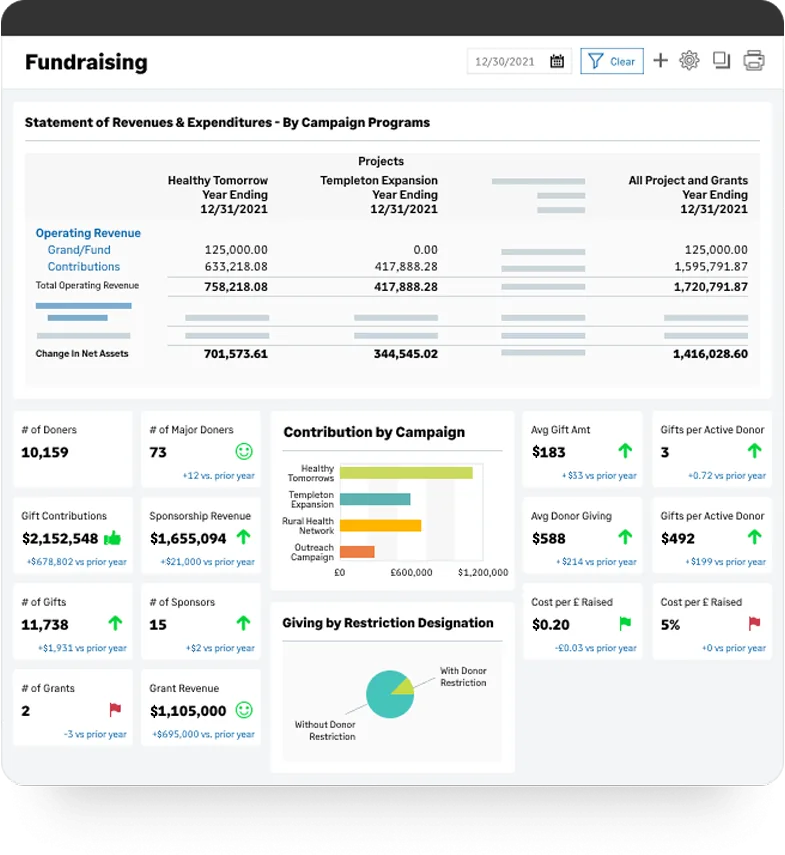
Release of restriction is where clean systems and messy ones separate. When a restricted gift is spent on its stated purpose, the amount moves from net assets with donor restrictions to net assets without them. If restriction lives as a dimension on the gift and on the spending, that release is a rules-driven entry the system can evidence. If it lives in a spreadsheet beside the ledger, the release is an opinion, and an auditor tests it first.
The same logic covers pledges, in-kind gifts and endowments. A promise to give is revenue when it is unconditional, so a receivable now and, for multi-year pledges, a discount unwinding over the term. Endowments need spendable and non-spendable portions distinguishable, and underwater positions visible before the board asks. Grant budgets belong where your operating budget lives, which is why budgeting and planning is configured in the same phase.
The FASB net asset classes and the statements they drive
Two classes, not three. Net assets with donor restrictions and net assets without them, with the older temporarily and permanently restricted distinction now carried in disclosure rather than in separate columns. Alongside that sit the functional expense analysis and a liquidity disclosure covering what is available to spend within the year.
Net assets with and without donor restrictions
Every gift needs its restriction captured when it is recorded, not decided later by whoever prepares the statements. The attribute belongs on the transaction, with a written rule for ambiguous cases. Board-designated funds are the classic trap: designations made by your own board are not donor restrictions, however carefully minuted.
Analysis of expenses by function and natural class
Program, management and general, and fundraising, crossed against salaries, occupancy, professional fees and the rest. Producing this from the ledger needs a functional dimension on every expense transaction plus allocation rules for costs that genuinely span functions. Write the allocation basis down and keep it consistent between years, because the comparison is what readers use.
Liquidity and availability
The liquidity disclosure asks what financial assets are available for general expenditure within a year, once amounts held under donor restriction or board designation are removed. It is straightforward when restriction is dimensional, and it is usually the disclosure that exposes a weak structure first.
Achieve real-time visibility with nonprofit financial reports and dashboards
Real-time visibility means the board book is a saved report group run against live data, not a folder of exports assembled by hand. The reports are largely the same reports. What changes is that nobody spends the week after close rebuilding them, and any figure on screen traces back to the transaction behind it.
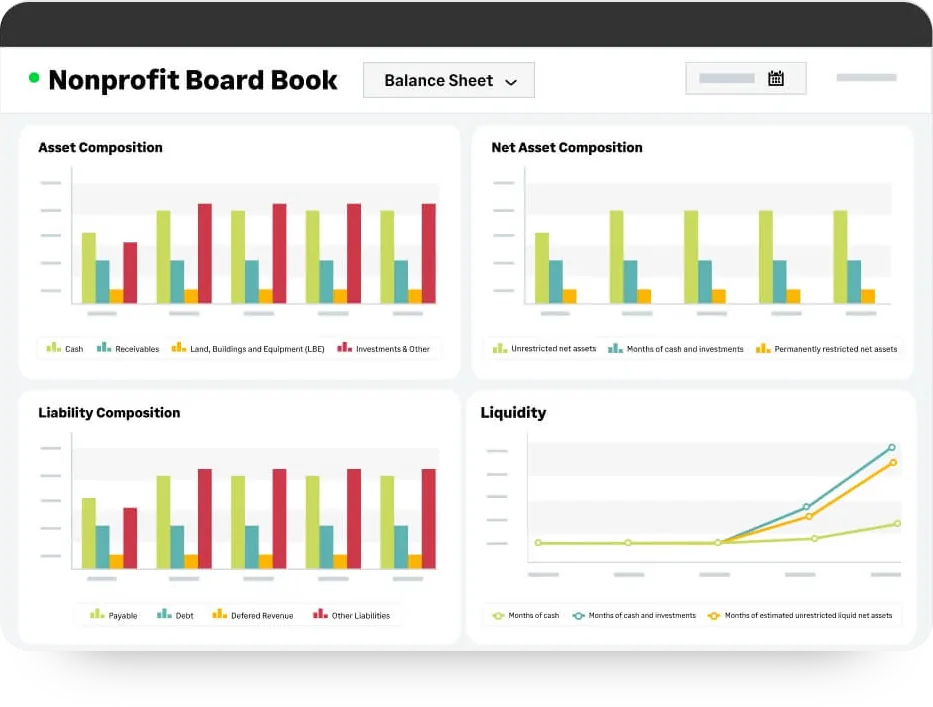
Build a small set of role-based dashboards rather than one for everybody: a finance view covering cash, receivables and payables, an executive view weighted toward program results and months of cash, and one program-director view. Three is usually right at go-live; twenty means twenty things to maintain, most abandoned by the second quarter.
The habit change matters more than the charts. When a trustee questions a number and it is clickable down to the posted invoice and its approval, the item closes in the meeting instead of carrying to the next. Our piece on dashboards and reporting covers the build order.
[DATA: Lucentive’s measured reduction in board-pack and grant-report preparation time across recent nonprofit implementations — Rich to confirm]
Maximize stewardship by automating manual processes and integrating systems
Three pieces of work usually run together in the second half of an implementation: automating the manual processing that eats your team’s week, connecting the systems that already hold your donor, payroll and grant data, and setting consolidation up so a group of entities closes once rather than four times.
Automating manual processes without weakening stewardship
Efficiency and control pull the same direction here, which surprises people. Routing an invoice through a defined approval path is faster than walking it around the office, and it produces the evidence your auditor asks for. What must not be automated away is segregation of duties: whoever sets up a vendor should not approve its payment, enforced by the system rather than by headcount.
Work smarter with seamless system integration
Your donor CRM, payroll system and grants tool already hold data your ledger needs. The integrations worth building first remove a re-key: gift batches summarized into the ledger with campaign and restriction attached, and payroll posted with labor allocated across programs and grants. Decide which system owns donor detail, and resist rebuilding the CRM inside accounting.
Simplify and speed consolidations across entities and chapters
Chapters, affiliates or a related foundation carry consolidation work that grows faster than the organization does. Handling it in the ledger means shared dimensions across entities, automated eliminations, and a consolidated view available at any point rather than assembled after every entity closes. The wider case is in our piece on consolidating and automating finances for multi-entity organizations.
What to check before you sign, and what vendor collateral cannot tell you
Vendor collateral tells you what the software can do. It cannot tell you whether your restriction history will migrate cleanly, who will configure your funds, or how your auditor will react to your allocation basis. Those are questions for the implementation partner, and they are worth asking before contracts.
Badges and review scores are worth what they measure and no more. A user-satisfaction badge says that people who own the product rate it. That is evidence about the product, not about whoever runs your project.

Ask harder questions instead. How many historical years are coming across, and with which dimensions attached? Restriction and grant attributes cannot be invented for transactions that never carried them, so decide which date your dimensional history genuinely starts from and design the first year of comparatives around that answer. Who is on your project team by name, and will those people still be there at user acceptance testing?
Then decide who inside your organization owns reporting after the consultants leave. A system with no named internal owner drifts back toward spreadsheets within two quarters, and the name has to be agreed during the project rather than discovered afterwards. Published customer stories help with the shape of that work, not with your numbers: read a case study for how an organization sequenced its project, never as a forecast. Sage publishes nonprofit references of its own, and the organizations in them are Sage’s customers rather than ours.

[DATA: Sage Intacct nonprofit edition licensing and implementation ranges for Lucentive’s typical nonprofit client size — Rich to confirm]
Summary
Nonprofit accounting software earns its keep in the structure, not the feature list. Define funds, grants, programs and restriction as dimensions before anything is loaded, agree who applies each tag and when, and the statements, grantor reports and board book all fall out of one ledger. Get it wrong and you have bought a faster way to do the same reconstruction.
If you are evaluating now, take last month’s board book and every grantor report you filed this quarter, and mark every figure assembled by hand. Bring that marked-up set to us. Our consultants will map each item to how it would be produced after implementation and say plainly which are straightforward, which need a process change first, and which your current data cannot produce at all. Start that conversation with our team whenever you are ready.
Frequently Asked Questions
What is nonprofit accounting and how does it work?
Nonprofit accounting reports finances around accountability to donors, grantors and the public rather than return to owners. It tracks each contribution’s purpose alongside its amount, so restricted gifts, grant awards and program spending are reported separately. The output is a statement of activities, a statement of financial position, an expense analysis by function and natural class, and a liquidity note.
What nonprofit accounting standards apply, and where do they come from?
United States nonprofits report under generally accepted accounting principles set by the Financial Accounting Standards Board, with the not-for-profit presentation requirements updated by ASU 2016-14. Organizations spending federal awards above the single audit threshold also fall under Uniform Guidance. State regulators and individual grant agreements add requirements on top, which is why grant-level tracking matters as much as the statements.
Is Sage Intacct a good QuickBooks alternative for nonprofits?
It is the usual next step for organizations that have outgrown entry-level bookkeeping, and the trigger is structural rather than volume-based. Teams move when restriction and grant tracking has migrated into spreadsheets beside the ledger, when several entities each need their own books plus a consolidated view, or when funder reporting takes longer than the close itself.
How do you record in-kind donations and pledges?
In-kind gifts are recorded at fair value when received, with the valuation basis documented alongside the entry. Contributed services are recognized only when they create or enhance a non-financial asset or require specialist skills. Unconditional pledges are revenue when promised, so a receivable now, with multi-year promises discounted over the term. Both carry the same restriction attribute as cash.
What should you look for in nonprofit accounting software for churches?
Church accounting is nonprofit accounting with a harder revenue side, so weight the evaluation there. You want a restriction attribute that separates donor-restricted giving from money your own board or elders designated, campaign and fund dimensions that report pledged, received and spent without a spreadsheet, a clean reconciliation between your giving platform’s batches and the ledger, and approval routing that keeps counting, recording and bank reconciliation in different hands.
What does Sage Intacct nonprofit pricing look like?
Licensing depends on the modules you enable, the number of entities you consolidate and how many users need access. Implementation is priced separately, according to how much data migration and integration the project carries. We will not publish a range we cannot stand behind for your situation.
[DATA: Lucentive’s current Sage Intacct nonprofit licensing and implementation ranges — Rich to confirm]