The test for hospitality accounting software is not whether it can produce a consolidated profit and loss. Almost anything can. The test is whether a general manager can see their own property’s numbers on the fourth working day, and whether head office can see all of them side by side without anyone building a spreadsheet.
Most multi-property operators fail that test for a structural reason rather than a software one. Each property was added to the ledger as it was acquired or opened, using whatever coding made sense at the time. Three years later the chart of accounts has grown a branch per site, comparisons need manual mapping, and adding property number twelve means another round of it.
This is a walk through what actually has to be true for property-level reporting to work, what the integration work really involves, and where these projects go wrong.
Key Takeaways
- Property-level reporting depends on entity and dimension design, not on reporting features. Get the structure right and the reports become configuration.
- Each property should be a location or entity dimension value, never a branch of the chart of accounts. Encoding sites into account numbers is what makes consolidation manual.
- The property management or point of sale integration is the largest risk in the project. Scope it first, because daily sales posting is where these implementations stall.
- Operating metrics such as cost per occupied room, labour percentage and sales per guest belong in the same system as the ledger, which means the statistical data has to be captured, not just the dollars.
- Adding a property after go-live should take days. If it takes a redesign, the original structure was wrong.
Screenshots throughout are Sage Intacct product material. The figures shown in them are Sage’s demonstration data, not Lucentive client results.
What hospitality accounting software has to do that general accounting does not
Three things. It has to report profitability by property, concept and region without manual mapping. It has to combine financial data with operating statistics such as covers, room nights and labour hours. And it has to absorb a new location or a disposal without anyone restructuring the ledger.
General accounting packages handle the first only if you build a separate company file per site, which is exactly what creates the consolidation problem. They handle the second badly, because they are built to hold currency amounts rather than counts of things. And they handle the third by making it somebody’s project.
Lucentive implements Sage Intacct for operators in this position because its dimensional structure addresses all three directly. Properties, concepts, regions and departments are tags applied to transactions rather than segments of an account code, which means the chart of accounts stays small while the reporting gets richer. That is the whole architectural argument, and it is worth understanding before you evaluate features.
Hotel and restaurant groups of real size already run on it. Benchmark, the global hospitality management company, is one of the customers Sage names, which is worth something as evidence that the platform copes at scale and worth nothing as evidence about your own build.

Property-level P&L and a structure that survives the next opening
The design decision that matters is where each property lives. In a well-built structure, a property is a location or an entity, and every transaction carries that value along with department, and often concept or brand. The chart of accounts describes what was spent. The dimensions describe where, by whom and under which banner.
Getting this right has a specific test attached. If opening a new site requires adding accounts, the structure is wrong. If it requires adding one location record and inheriting everything else, the structure is right. That difference is the practical meaning of software that adapts as you grow, and it is not a feature you can switch on later. It is a decision made in week two of the implementation.
Multi-entity operators have a further question: which properties are separate legal entities and which are cost centres within one. Ownership structures in hospitality rarely follow the operating structure, particularly where management companies run properties they do not own. The system handles both, with consolidation and inter-entity postings across legal entities and dimensional reporting within them, but you have to map the two structures explicitly rather than assume they match. We cover the wider mechanics in our piece on consolidating and automating multi-entity finances.
Cloud delivery matters here for a practical reason rather than an ideological one. Properties are distributed, general managers are not in head office, and nobody wants a server in a back office at each site. One system reached from any property means the numbers a general manager sees and the numbers head office sees are the same numbers at the same moment.
The metrics hotel and restaurant finance teams actually put on a dashboard
Financial figures alone do not run a hospitality business. The dashboards that get used pair dollars with operating statistics: labour as a percentage of sales, sales per square foot, sales per guest, covers served, and profit by concept or property against the same period last year.
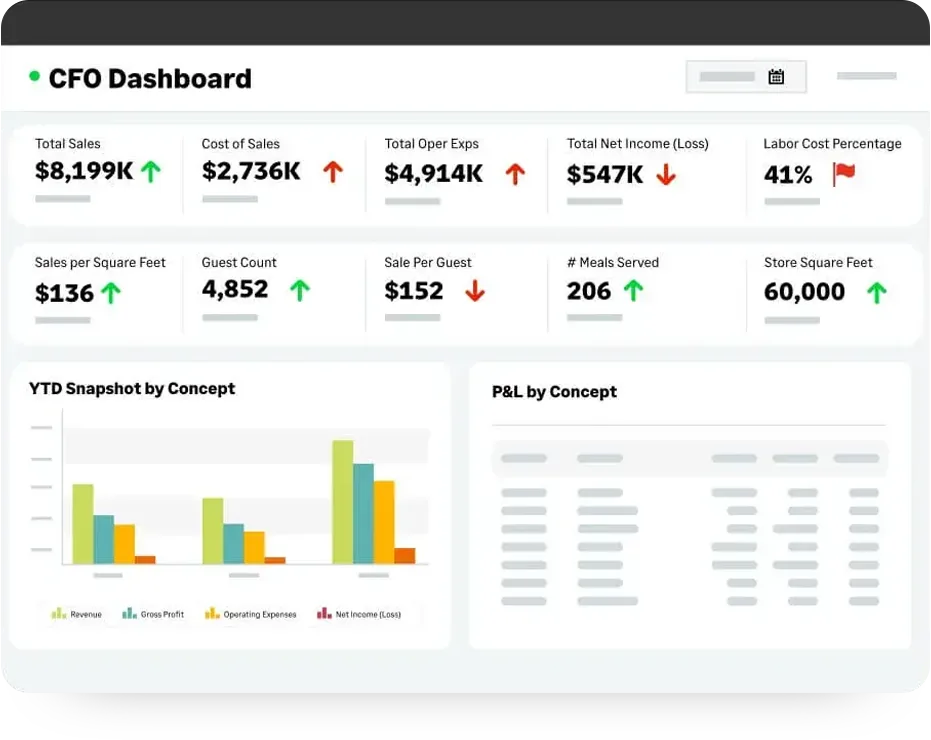
The important detail in a view like this is that the statistical values sit in the same system as the financial ones. Guest count, square footage and meals served are held as statistical accounts, which is what allows a ratio like sale per guest to be calculated and trended without an export. If those numbers live in a spreadsheet on someone’s desktop, you get a financial dashboard and a separate operating report, and the two disagree by the middle of every month.
This has an implementation consequence people miss. Somebody has to feed the statistics in. Either the point of sale or property management system posts them on a schedule, or an operations manager enters them. That has to be designed and owned, and it is the single most common reason a beautiful hospitality dashboard is half empty six months after go-live. More on the reporting layer generally is in our guide to dashboards and reporting.
Property management and point of sale integration: where the numbers come from
The accounting system is not the system of record for room nights or covers. The property management system and the point of sale are. The integration that carries daily revenue, tax, tips, discounts and payment settlement into the ledger is the load-bearing part of the project, and it should be scoped before anything else.
What that integration usually looks like is a daily sales journal per property, summarised rather than transaction by transaction, posting revenue by category, taxes by jurisdiction, discounts, comps, and the payment settlement lines that need to reconcile to the bank. Getting the mapping right is detailed work. Getting the reconciliation right is detailed work that continues after go-live, because settlement timing and card processor fees do not line up neatly with the sales day.
Two honest warnings. First, integration quality varies enormously by system, and the answer to “does it integrate?” is almost never a simple yes. Ask which method, who supports it, and what happens when a day fails to post. Second, restaurants and hotels differ here. Restaurant groups usually need per-day, per-location sales journals and heavy labour data. Hotels need room revenue split by segment, plus food and beverage, plus ancillary revenue, and often a management agreement layer on top. They are not the same integration project.
Deferred revenue, gift cards, management fees and the other awkward parts
Hospitality generates several revenue types that a simple ledger handles badly: gift card and voucher liabilities, deposits and advance bookings, loyalty programme obligations, management and franchise fees, and revenue shares with owners. Each needs an explicit design decision rather than a default.
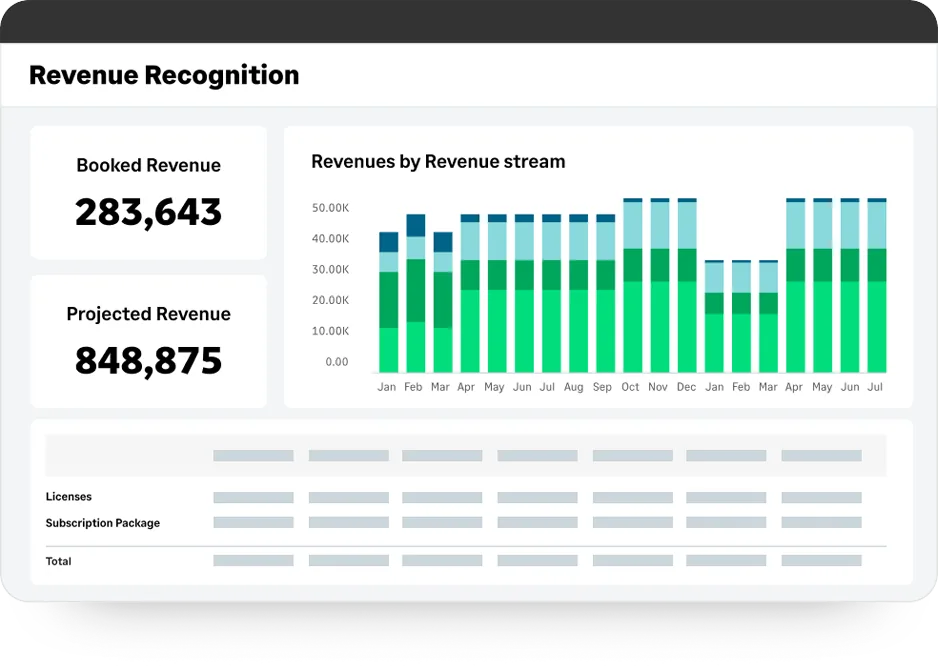
Deferred and scheduled revenue is the area that most often justifies a proper finance platform rather than a bookkeeping package. Advance deposits sit as a liability until the stay happens. Gift cards sit as a liability until redeemed or until breakage is recognised under your policy. Management fees are calculated from other people’s revenue on a contractual formula. All of these can be scheduled and recognised automatically once configured, and all of them are a monthly manual journal otherwise.
The implementation work here is largely accounting policy work rather than software work. Somebody has to write down the breakage policy, the deposit recognition trigger, and the exact fee calculation in each management agreement. In our experience that documentation does not exist in a usable form at the start of most projects, and producing it is a genuine benefit of the exercise even before anything is configured.
Where hospitality implementations get stuck
Hospitality projects have a distinctive failure profile, and it is rarely the ledger. Four patterns recur: the sales integration scoped too late, statistical data with no owner, an old site-per-branch account structure carried across unchanged, and property managers told about the new reporting rather than involved in designing it.
The integration is scoped last
It should be scoped first. If daily sales posting is not proven by the middle of the project, the go-live date is at risk regardless of how well the ledger is configured.
Nobody owns statistical data
Covers, room nights, occupied rooms and labour hours need a source and an owner. Without both, the operating metrics on your dashboard stay blank and the project is judged on the half that works.
The old account structure is carried across
Migrating a site-per-branch chart of accounts into a dimensional system reproduces the original problem in a better product. Rebuild the structure, map the history to it, and accept a defined boundary for comparatives.
General managers are told rather than involved
Property-level reporting only changes behaviour if property managers use it. That is a change management problem, not a configuration one, and it is worth reading how we approach change management during an implementation before you plan the rollout.
None of those four turn up in a vendor comparison. What turns up instead is a wall of badges. Sage Intacct carries G2’s Users Love Us mark, awarded on the strength of verified user reviews, and you will see it on nearly every page you read during this evaluation. It is a real signal about the product, it is Sage’s award rather than Lucentive’s, and it will not tell you whether your point of sale can post a clean daily journal.

Summary
Hospitality finance teams do not need more reports. They need a structure where the report they want already exists because the transaction was tagged correctly when it was entered. Properties as dimensions, statistics captured alongside dollars, the sales integration proven early, and the awkward revenue policies written down before configuration begins.
[DATA: Lucentive’s hospitality client mix and property counts — Rich to confirm]
[DATA: Lucentive’s typical multi-property consolidation close time after go-live — Rich to confirm]
The page this replaces offered a datasheet and an eBook behind a form. Neither can tell you whether your ownership structure, your management agreements and your point of sale will fit together cleanly, which is the only question that determines whether a project like this goes well. Bring us your property list, your entity structure and the name of your point of sale, and we will tell you what the real scope looks like. Start a conversation with our team, or read more on the reporting side in real-time reporting and visibility.
Frequently Asked Questions
What is the best restaurant accounting software?
There is no single answer, and any vendor giving you one is selling. The useful question is whether you need an industry suite that bundles accounting with scheduling and recipe costing, or a financial platform that integrates with the operational systems you already run. Single-concept operators often prefer the suite. Multi-concept and multi-entity groups usually need the platform, because the consolidation and ownership complexity outgrows the suite first.
How does this compare with a restaurant-specific system such as Restaurant365?
They solve overlapping problems from different directions. A restaurant-specific suite bundles operational tools with the accounting and is strongest when every location runs the same way. A financial platform is strongest when the finance complexity is the hard part: several legal entities, mixed ownership, management agreements, or multiple concepts under one group. Evaluate on where your complexity actually sits, not on feature counts.
Can it replace our property management system?
No, and it should not try. The property management system owns reservations, rates and the guest record; the point of sale owns the check. The accounting platform owns the ledger, the consolidation and the reporting. The integration between them is what makes the arrangement work, which is why that integration deserves more scoping attention than any other part of the project.
Does this make sense for a single restaurant or a small cafe?
Usually not. A single site with one legal entity and a simple ownership structure is well served by small business bookkeeping software plus a good point of sale. The case for a finance platform appears with the second and third entity, with mixed ownership, or with reporting obligations to owners and lenders that a bookkeeping package cannot produce without manual work.
How do we report profitability by property when costs are shared?
Shared costs are allocated, and the allocation rules are configured rather than calculated by hand each month. Regional overhead can be spread by revenue, by room count, by square footage or by any statistic you capture. The important part is agreeing the basis with the people whose results it affects before go-live, because an allocation nobody accepts becomes an argument every month.
How long does an implementation take?
The ledger configuration is not the long pole. The timeline is driven by how many properties are in scope, how clean the existing data is, and how much integration work the point of sale and property management systems require. A phased approach that brings a pilot property live first, proves the daily sales posting, and then rolls out the rest is almost always faster in practice than a single cutover.