Real estate accounting software gets evaluated the month somebody counts the entities. A property company that started with four buildings and one bookkeeper wakes up with nineteen legal entities, a separate set of books for each, a consolidation workbook that takes a week, and an investor who wants quarterly reporting by fund rather than by property. The accounting was never wrong. It was just never designed for this many of anything.
The pattern is familiar because it happens to almost every owner-operator that grows. Each acquisition brings its own entity for good legal and lender reasons. Each entity brings its own chart of accounts, its own close, and its own contribution to a group picture that nobody can produce quickly. By the time a lender asks for a property-level statement and a fund-level roll-up in the same week, the workbook has become the system.
This is what replacing that actually involves. What has to be designed before anything moves, how property, unit and lease reporting is structured, what investor reporting looks like afterwards, and where property companies stall in the middle of the project.
Key Takeaways
- Entity structure and dimension structure are two separate decisions, and confusing them is the most common design error. A property does not have to be an entity to be reported on.
- Consolidation is continuous rather than a month-end exercise, which is what makes a portfolio of twenty entities behave like one set of books without giving up entity-level statements.
- Property, unit and lease reporting depends on those dimensions being applied at entry, including on the transactions that arrive from a property management system.
- This is a financial system, not a property management platform. Leasing, maintenance and tenant portals stay where they are, and the integration boundary is worth settling before configuration starts.
- The change most operators notice is not a faster close. It is that a lender or investor request stops being a project.
Screenshots throughout are Sage Intacct product material. The figures shown in them are Sage’s demonstration data, not Lucentive client results.
What real estate accounting software has to do that general accounting does not
It has to produce a statement for every legal entity, a rolled-up view by fund, region or portfolio, and an operating view by property, unit and lease, all from the same records. Add common area maintenance recoveries, percentage rent, escalations, capital versus operating expense treatment, and distributions to investors owning different slices, and general accounting runs out quickly.
Sage Intacct Real Estate handles that through a dimensional ledger with native multi-entity support. Entities share one chart of accounts and one dimension structure, so a property, a unit, a lease or a fund is a tag on the transaction rather than a separate set of books. That combination is why real estate owners, operators and property managers tend to shortlist it: the entity count stops being the constraint on how fast you can close.
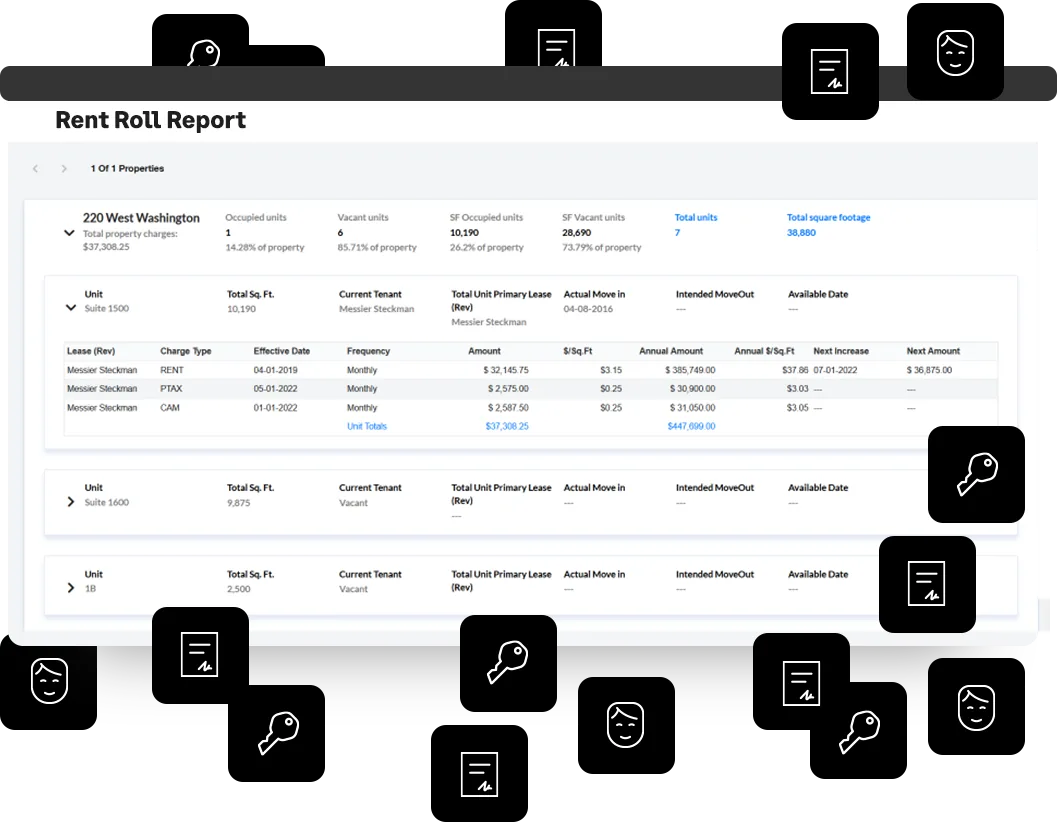
The rent roll is a good illustration of what changes. Instead of being assembled from a property management export and a general ledger export that disagree by a small amount nobody can explain, occupancy, lease charges, escalation dates and annualized amounts come from the same records the financial statements come from. When somebody questions a figure it is clickable rather than arguable.
Entity structure and dimension structure are two different decisions
This is where most design sessions start and where the most expensive mistake gets made. A property needs its own legal entity when a lender, a joint venture agreement or a tax position requires separate books. It does not need one merely to be reported on separately, because that is what dimensions are for.
The distinction matters because entities carry overhead. Each one has its own close, its own intercompany relationships and its own reconciliation. Dimensions carry almost none. We routinely find portfolios where a dozen entities exist for reporting reasons that a dimension would serve better, and reducing that count is one of the quieter wins of a well-run implementation.
Where separate entities genuinely are required, continuous consolidation is what makes the volume manageable. Eliminations, ownership percentages and currency translation are configured once and applied as transactions post, so a group or fund view is available whenever you look rather than after a monthly exercise. The broader case is set out in our article on consolidating and automating finances for multi-entity organizations.
The scalability argument is genuinely about this, and it is worth being precise rather than promotional. Adding a property to a dimensional structure is a new dimension value and a mapping decision. Adding one to a spreadsheet consolidation is a new tab, a new set of formulas, and a new place for the model to break. The difference does not show at four properties. It shows at forty.
Property, unit and lease: getting the dimensions right
Property, unit and lease are the dimensions that carry most of the operational reporting, and they need to be defined before any data moves. A transaction tagged with property but not unit can never produce unit-level analysis, and re-tagging history is manual work nobody enjoys twice.

The design session works backwards from questions rather than forwards from a template. Which reports does your lender require and at what level. What does the asset management team ask for that currently takes a day to produce. How do you want to see recoverable versus non-recoverable expense, and does that split need to be a dimension or an account. Each answer becomes a structural decision, and each structural decision needs a rule about who applies it and when.
Two questions come up on nearly every project. Whether tenant should be a dimension separate from customer, which usually depends on whether one tenant occupies space across multiple properties. And how far down the unit hierarchy to go, where the honest answer is as far as somebody will actually maintain, not as far as the system permits. Detailed data that is entered carelessly is worse than coarse data that is entered accurately, and our piece on how Sage Intacct dimensions work covers the trade-off in more depth.
Common area maintenance is worth its own conversation during design. Recovery calculations, pro-rata shares and the annual reconciliation are operationally specific, and they are one of the areas where the boundary between the financial system and the property management system needs to be drawn explicitly rather than assumed.
Investor, lender and joint venture reporting
Data-driven insights in this sector mean something narrower than the phrase suggests. It means the person who owns a slice of a property can be told what their slice did, on demand, without an analyst rebuilding it. That depends entirely on whether ownership, fund and investor structures were captured as dimensions rather than as knowledge held by one person.

Once they are, the reporting layer does the rest. Statements by property, by fund and by ownership percentage come from the report writer, distributions can be calculated against actual ownership rather than a maintained spreadsheet, and every figure drills to the posting and the source document behind it. Our guide to Sage Intacct dashboards and reporting covers how to sequence that build so nobody trains on a structure that is still moving.
The practical test we use in an assessment is simple. Take the last three investor or lender requests that took more than a day, and ask what would have had to be true at transaction entry for each to be a report instead. That exercise usually surfaces one or two dimensions nobody had thought of, and it is far cheaper to discover in week two than in month nine.
[DATA: Lucentive’s measured reduction in investor reporting preparation time across recent real estate implementations — Rich to confirm]
What a real estate implementation actually takes
The configuration is measured in weeks. The design of entity and dimension structure, the integration boundary with your property management platform, and the migration of open balances across many entities are what set the timeline, and they depend on your team’s availability more than on ours.
The integration decision deserves more attention than it usually gets. Leasing, tenant communication, work orders and maintenance stay in the property management system. What crosses the boundary is normally a summarized posting of rent charges, receipts and recoveries, at the level of detail your reporting requires. Deciding that level of detail is a reporting decision disguised as a technical one, and getting it wrong in either direction is painful: too summarized and property reporting is thin, too granular and you are duplicating a subsidiary ledger for no benefit.
Migration is more manageable here than in most sectors, because open balances plus a defined period of history is usually sufficient and depreciation schedules carry across cleanly. The volume, not the complexity, is the work. Twenty entities means twenty trial balances to reconcile, and that is a scheduling problem for your controller rather than a technical one.
Robust industry expertise is the phrase the retired page used, and it is worth translating into something checkable. What you actually want from an implementation partner is consultants who have set up CAM recovery before, who will argue with you about whether a property needs an entity, and who know which property management integrations behave well. Ask any partner to describe the last real estate implementation they finished and what went wrong in it. Our consultants have decades of individual experience each, and the useful version of that is the specific questions they ask in the first workshop.
One credential does travel with the product rather than with the partner, and it is worth knowing exactly what it covers. Sage Intacct is the preferred provider of financial applications for the American Institute of CPAs, through the institute’s business solutions arm. That is a statement about the software’s accounting rigour and its standing with the profession.

Where property companies get stuck
Three patterns account for most of the trouble we are called in to unpick on property portfolios, and none of them is a software fault. Each is a decision that was inherited rather than made, or postponed until the structure it would have shaped was already carrying live transactions across a dozen entities.
Every property becomes an entity
Usually inherited from how the books were always kept. It multiplies close effort permanently for reporting that a dimension would have delivered. Challenge each entity against a legal, lender or tax reason, and keep only the ones that have one.
The integration boundary is left undefined
When nobody has decided which system owns the lease record, both do, and they diverge within a quarter. Settle ownership of each record type in writing during design, and give one system the authority.
Dimension design deferred until after go-live
The expensive one, in this sector as in every other. Dimensions are cheap to define at the start and costly to retrofit, because retrofitting means re-tagging transactions that have already posted across many entities.
What changes after go-live
The close gets shorter, and the effect compounds with entity count. A single-entity operator notices a modest improvement. A portfolio closing twenty entities notices a large one, because the consolidation step that used to be a week is no longer a step at all. Plan for the first close after go-live to be slower than your old one.
[DATA: Lucentive’s typical number of property entities consolidated for recent real estate clients — Rich to confirm]
The second is usually about even, and the third is where the gain appears. The change operators mention later is different. Requests stop being projects. A lender asking for a property-level statement, an investor asking for their share of last quarter, an asset manager asking which units are rolling next year: each becomes a report someone runs rather than a task that lands on the controller. That is what cost-effective growth actually looks like in practice, and it is why the finance headcount curve flattens while the portfolio keeps growing.

Hear the trade-offs before you commit. Data entry gets slightly heavier because dimensions are applied when a transaction is created. Somebody owns the dimension structure and that ownership needs a name against it. And once investors and lenders learn that reporting is easy, they ask for more of it.
Summary
The leverage in a real estate implementation sits in three decisions rather than in features. Separate the entity question from the reporting question, and stop creating entities for reasons a dimension would serve. Define property, unit, lease and ownership dimensions before anything is loaded. Draw the boundary with your property management platform explicitly, in writing, before configuration starts. Get those right and property, fund and investor reporting all come from one ledger with nothing reconciled in between.
The page this post replaces offered an eBook, a datasheet, a product sheet and a form. Those describe capability, which is the easy part of this decision. They cannot tell you how many of your entities are unnecessary or where your property management integration will leak. If you are evaluating now, bring your entity list and your last investor reporting pack. Our consultants will tell you which entities could be dimensions and which reports would become reports rather than projects. Developers running construction alongside operations may also want our piece on construction job costing and WIP, or you can start a conversation with our team.
Frequently Asked Questions
Does this replace Yardi or MRI?
Usually not, and you should be cautious of anyone who says it does. Yardi and MRI are property management platforms with leasing, maintenance, tenant portals and residential operations built in. This is the financial system underneath. Most owner-operators run both and integrate them, with the property platform owning the lease and the financial system owning the ledger. Replacement only makes sense for portfolios whose property operations are genuinely light.
Is this property management accounting software?
It is the accounting half of that description rather than the whole of it. Rent roll reporting, lease charge detail, CAM recovery, entity consolidation and investor reporting all live here. Day-to-day property operations, prospect and applicant tracking, work orders and tenant communication do not. If you are searching for one system to do both, be clear which half your real pain sits in before you shortlist.
Does it handle commercial and residential portfolios?
Both, though the design emphasis differs. Commercial work concentrates on lease structures, escalations, recoveries and percentage rent, which is where the dimension design effort goes. Residential concentrates on volume, turnover and unit-level occupancy, where the integration with the property platform matters more than the lease detail in the ledger. Mixed portfolios are common and are handled through the same structure rather than through separate systems.
What does AICPA Preferred mean?
Sage Intacct is the preferred provider of financial applications for the American Institute of CPAs through its business subsidiary, an endorsement that has been in place for years. It is a genuine signal about the platform’s accounting rigor and its standing with the profession. It says nothing about any particular implementation partner, and it is not a substitute for asking a partner what they have actually built in your sector.
How many entities can it handle?
Far more than most property companies have, and entity count is rarely the technical limit. The practical limit is your own operating discipline: how consistently entities share a chart of accounts, how intercompany transactions are handled, and whether ownership structures are maintained. Portfolios that struggle at scale usually struggle because those conventions drifted, not because the system ran out of capacity.
Is there free real estate accounting software worth considering?
For a single-property owner with straightforward books, entry-level and free tools are a reasonable place to start and there is no merit in buying structure you do not need. The case for a platform like this begins when you have multiple entities, investors or lenders requiring reporting on their own terms, or a consolidation that has become somebody’s monthly job. Those are the conditions the cost is justified against.