Ask a distributor what their gross margin was last month and you will get an answer. Ask what it was on one SKU, sold to one customer, out of one warehouse, after freight in, duty, brokerage and the rebate you accrued but have not received, and the room goes quiet. That second number is what distribution accounting software is supposed to produce, and most systems in this industry do not.
The reason is rarely that anyone is careless. It is that landed cost, inventory valuation and customer-level profitability each live in a different place: the purchase order, the freight invoice that arrives three weeks later, and a spreadsheet somebody maintains. By the time all three agree, the quarter is closed.
What follows is the implementation view of closing that gap. What has to be decided before configuration starts, which parts of your month disappear, and where these projects actually stall.
Key Takeaways
- Real margin by item, customer and warehouse comes from landed cost handling and dimension design, not from a report you turn on.
- Freight, duty and brokerage that arrive after the goods do are the hardest accounting problem in distribution. Decide how you will accrue them before go-live.
- Sage Intacct handles inventory, purchasing and distribution well. It is not a manufacturing execution system, and treating it as one is the expensive mistake in this sector.
- Warehouse transfers and cycle counts are where inventory accuracy is won or lost, and both are process decisions before they are software settings.
- Your item master is the migration risk. Duplicate SKUs and inconsistent units of measure move go-live dates more than anything else.
- Scaling to a new warehouse, entity or currency should be a configuration change, not a project. Design for that on day one.
Screenshots throughout are Sage Intacct product material. The figures shown in them are Sage’s demonstration data, not Lucentive client results.
What distribution accounting software has to do that general accounting cannot
Three things: value inventory correctly as costs change, absorb landed costs that arrive after the goods, and report margin across item, customer, warehouse and product line at the same time. General small-business accounting does the first badly, the second not at all, and the third only through export and rebuild.
The inventory valuation piece is the one people underestimate. Whether you run average cost, standard cost or FIFO changes what your margin means, what your balance sheet says and how much explaining your auditors ask for. Most distributors have inherited a method rather than chosen one, and an implementation is the moment that decision gets revisited. Do it deliberately, with your accountant in the room, because switching afterwards is disruptive.
The reporting piece is where dimensions earn their keep. Item, product line, warehouse, location, customer and sales rep become tags on the transaction rather than segments buried in an account code. Once they are, margin by any combination is a filter on data you already have. Our explainer on how dimensions replace a bloated chart of accounts covers the mechanics; the distribution-specific part is deciding how granular your product hierarchy needs to be before you have twenty thousand SKUs tagged inconsistently.
Landed cost and the margin number you can actually defend
Landed cost is the total cost of getting an item into your warehouse and available to sell: purchase price plus freight, duty, brokerage, insurance and handling. The accounting difficulty is timing. The goods arrive, you sell them, and the freight invoice shows up weeks later, by which time the margin you reported was wrong.
There are two workable approaches and you have to pick one. Estimate landed cost at receipt using a rate per unit, per weight or per value, then true it up when the actual invoice lands. Or hold receipts in a staging state until costs are known, which is cleaner but delays your ability to sell against the inventory. Most distributors we work with use estimation with a true-up, because sales will not wait. Either way the decision belongs to finance and operations together, and it belongs at the start of the project.
Rebates and vendor allowances deserve the same treatment. If a meaningful share of your margin comes from volume rebates you earn now and receive later, the accrual method you choose determines whether your monthly margin is real or optimistic. This is the single most common place we find distribution reporting quietly overstating profitability.
Streamlining warehouse management
The accounting side of warehouse management is narrow and important: receiving, putaway, transfers between locations, cycle counts and the adjustments that follow. Get those recorded accurately in the ledger and your inventory number is trustworthy. Get them approximated and every downstream margin report inherits the error.
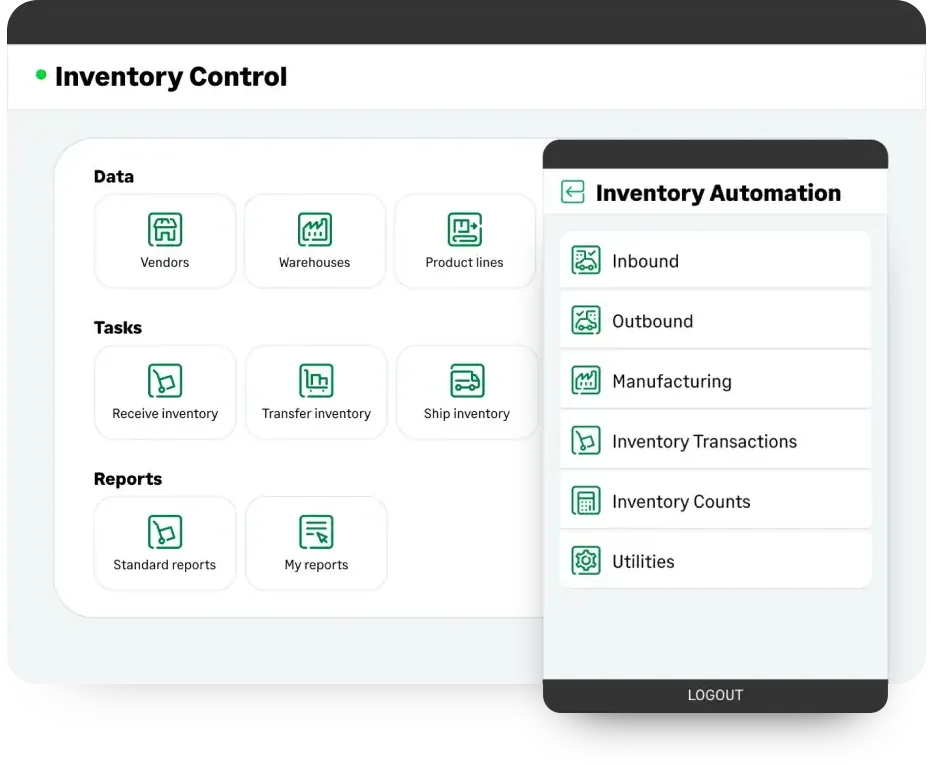
Transfers are the usual weak point. When stock moves between warehouses without a transaction, two locations are wrong at once and nobody notices until a count. The fix is process before software: decide who is authorised to move stock, require a transfer document, and make the system the only way it happens. Configuration supports that decision; it cannot substitute for it.
Cycle counting is the second. Counting everything once a year produces a large annual adjustment and no operational insight. Counting high-value and high-velocity items frequently produces small corrections and an inventory number you can believe in between counts. That change costs nothing in software and is often the biggest single improvement in a distribution implementation.
Approvals sit alongside this. If purchase orders are approved by forwarding an email, you have no audit trail and no spend control. Our note on the benefits of a real purchase order system covers what changes when approval lives on the transaction instead.
Distribution dashboards and reports that get used
Four views cover most distribution leadership needs: margin by product line and item, inventory velocity separating fast movers from dead stock, customer profitability after freight and terms, and a live cash and receivables picture. Build those before anything else gets requested.
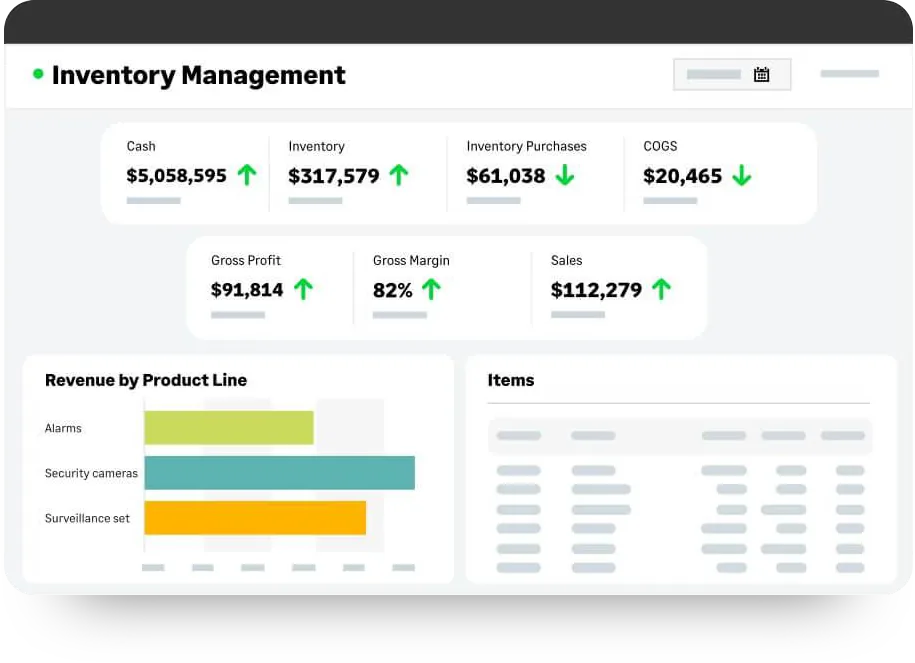
Inventory velocity is the report that changes decisions fastest. Knowing which items turn and which have been sitting since two winters ago is the difference between a working capital problem and a purchasing plan. Shrinkage, shipping errors and stock-outs belong on the same screen, because each of them is a margin leak that a revenue report will never show you.
Customer profitability is the uncomfortable one. Once freight, payment terms, returns and order size are attributed properly, most distributors discover that some of their largest customers are among their least profitable. That is a useful thing to know and an awkward thing to circulate. Decide who sees that report before you build it.
Making the right connections
A distribution ledger is never alone. Around it sit EDI with your trading partners, an ecommerce storefront, a warehouse management or 3PL system, a shipping platform, and sales tax automation such as AvaTax for multi-state or cross-border selling. Sage Intacct publishes an API and maintains a marketplace of prebuilt connectors for most of these.
Take the connector list as a starting point rather than an answer. “There is a connector” and “the connector maps your item, warehouse and tax codes correctly” are different statements, and the second is only proved by testing against a real month of your transactions. Sales tax is where this bites hardest, because a mapping error there is a compliance problem rather than a reporting inconvenience.
Order to cash is the flow that touches all of it. If you want the detail on where that sequence breaks between the order, the pick, the invoice and the payment, our pieces on what order processing actually involves and where order-to-cash breaks go through it step by step.
Scaling the business, and what the implementation takes
Adding a warehouse, an entity or a currency should be configuration rather than a project. That is the practical meaning of scaling without adding finance headcount, and it holds only if the original design anticipated growth. Retrofitting a second entity onto a structure built for one is real work.
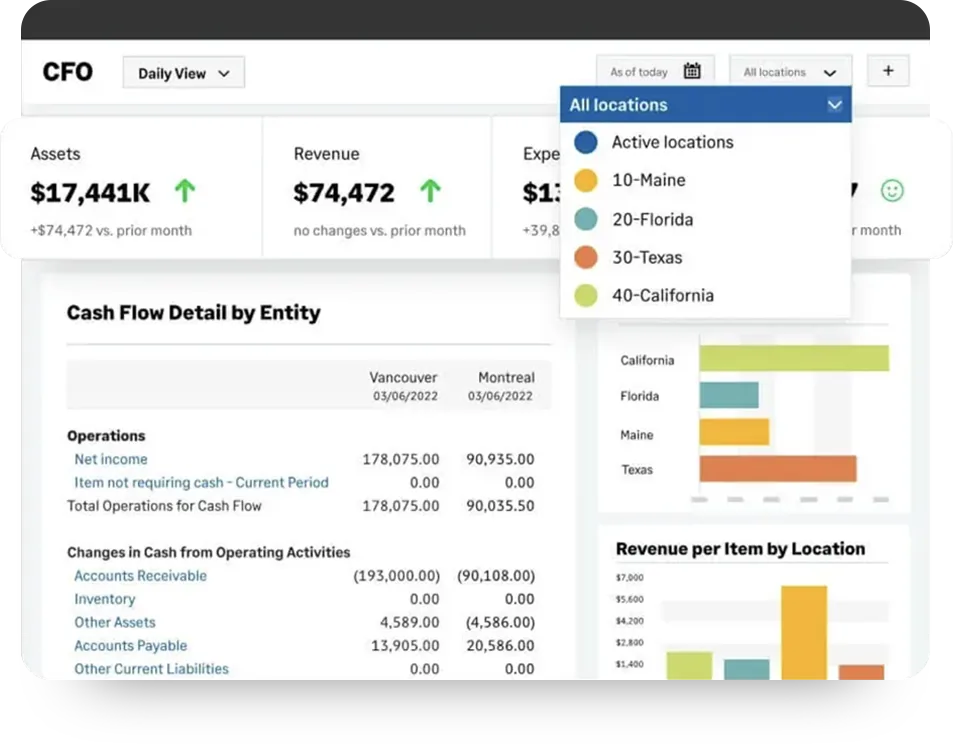
On the implementation itself, four workstreams run at once: dimension and product hierarchy design, item and customer master migration, integration testing, and rebuilding approvals. Configuration is the smallest. The item master is the risk. Duplicate SKUs, inconsistent units of measure, and vendor part numbers used as item codes are all normal, all client work to clean up, and collectively the most common reason a go-live date moves.
[DATA: Lucentive’s typical implementation timeline for a multi-warehouse distributor — Rich to confirm]
[DATA: order-processing cost reduction Lucentive has observed with distribution clients — Rich to confirm before we publish a figure]
One honest limit. If your operation includes real production, with bills of material, routing and shop-floor scheduling, this is a financial and distribution platform rather than a manufacturing system. The right answer is either a manufacturing ERP or this plus a genuine production system and an integration budget. We would rather tell you that now than in month four.
Two proof marks sat at the bottom of the page this one replaces, and both are worth reading for exactly what they are. One was a quote from a small, fast-growing consumer brand describing how much finance housekeeping disappeared once reporting ran live. The other was a peer-review award. Neither says anything about your warehouses, your item master or your freight accrual, and neither belongs to Lucentive. Take them as evidence that the platform holds up in the field, then ask the question they cannot answer: who is designing your product hierarchy and your landed-cost method, and what will your margin report be assembled from once they have finished.


Summary
Wholesale distribution accounting is not difficult because the transactions are exotic. It is difficult because the number that matters, true margin on a specific item to a specific customer out of a specific warehouse, is assembled from costs that arrive at different times. Fixing that means deciding how you value inventory, how you absorb landed cost, how you accrue rebates, and which dimensions every transaction will carry.
Make those four decisions well and the reporting follows almost for free. Make them late and you will have bought an expensive version of the spreadsheet you already have. The white paper, the infographic and the eBook on a vendor site will not make those decisions for you. Talk to Lucentive and bring your item master and your last freight accrual.
Frequently Asked Questions
What is the best inventory accounting software for a wholesale business?
It depends on whether your constraint is warehouse operations or financial reporting. If you need barcode scanning, bin management and pick optimisation, you want a warehouse management system alongside your ledger. If your constraint is margin visibility, landed cost and multi-entity consolidation, you need a financial platform with real inventory capability. Most growing distributors end up running both and integrating them.
Is QuickBooks enough for a distribution business?
For a single warehouse, a modest SKU count and simple costing, it often is. It stops being enough at fairly predictable points: a second warehouse, a second legal entity, landed costs that need absorbing after receipt, or a need to see margin by item and customer at the same time. If you are working around the system with spreadsheets every month, you have already passed that point.
How is landed cost handled in practice?
Costs are allocated across a receipt using a chosen basis such as quantity, weight or value, then either estimated at receipt and trued up when the actual invoice arrives, or held until costs are known. Estimation with a true-up is more common because it lets you sell immediately. The important part is choosing the basis and the true-up cadence deliberately, since both directly shape the margin you report.
Can I see profitability by customer as well as by product?
Yes, provided customer is treated as a dimension and the costs that vary by customer are attributed rather than pooled. Freight, payment terms, returns rates and order size all change customer profitability, and if they sit in a general overhead bucket your customer report will be flattering and wrong. The design work is deciding which costs get attributed and on what basis.
How long does a distribution implementation take?
The drivers are your number of warehouses and entities, the condition of your item and customer masters, and how many integrations sit around the ledger. A single-warehouse distributor with a clean item list moves quickly. A multi-warehouse group with duplicate SKUs, EDI trading partners and an ecommerce channel takes considerably longer, and most of the extra time is data cleanup and integration testing rather than configuration.