Open your chart of accounts and count the rows. The Sage Intacct general ledger exists to remove the compromise you are probably looking at. If your business grew on a ledger somebody set up years ago, that number is likely in the hundreds and may be over a thousand, and most of those rows are not accounts at all. They are locations, departments, funds, programs and product lines that somebody encoded into the account number because the old system had nowhere else to put them.
The idea is easy to state and takes real work to apply. You keep a short list of natural accounts, the things that genuinely are accounts, like rent expense or accounts receivable. Everything else about a transaction travels alongside it as a dimension tag: which site, which department, which project, which funding source. The ledger then answers “by what?” at report time, instead of forcing you to decide the answer years earlier when you numbered the account.
What follows is what that shift involves: what shrinks, what has to be designed before a record is loaded, where projects stall, and what a finance team’s month looks like afterwards.
Key Takeaways
- A dimensional general ledger separates what an amount is (the account) from everything else about it (the dimensions). That separation is why chart of accounts counts fall sharply during implementation.
- Dimension design is the highest-leverage decision in the project and belongs before the first data load. Adding a dimension later means re-tagging history to make it useful.
- Consolidation runs continuously against the same ledger rather than as a separate month-end exercise, so entity views and group views stay in step.
- Historical transactions cannot carry dimension values they never had. Choose the date your dimensional history begins, and tell leadership that date before the first comparative report circulates.
- The close gets shorter, but the larger change is in the questions finance receives, because operational leaders can answer the routine ones without asking.
Screenshots throughout are Sage Intacct product material. The figures shown in them are Sage’s demonstration data, not Lucentive client results.
What the Sage Intacct general ledger does differently
The Sage Intacct general ledger records every transaction as an account plus a set of dimension tags rather than as one long coded account string. The account number describes only the nature of the amount. Location, department, project, customer, vendor, item, employee and any dimension you define ride alongside it on every posting line.
That sounds like a technical detail and it is really a structural one. In a segmented ledger, each new way of looking at the business costs you a segment, and segments multiply. Two locations and four departments is eight combinations; a third location and a fifth department makes fifteen. Nobody notices the compounding until a new site opens and finance spends a week creating accounts.
In a dimensional ledger, a new site is one new dimension value. The chart of accounts does not change, and every report built on those accounts picks up the new site automatically. That single property is why the architecture holds up as an organization grows, and it is the strongest technical argument for the platform over the tools most companies arrive from.
There is a constraint attached, and it is worth hearing early. The ledger can only slice by what it was told at entry. If a dimension is not captured on the transaction, no configuration will recover it later. Dimensional accounting is therefore as much a process design exercise as a software one, which is the theme of our companion piece on how Sage Intacct dimensions actually work.
What happens to your chart of accounts
Your chart of accounts gets much shorter. Teams arriving from a coded account string routinely cut their account count by a large margin, because most of what they were maintaining was never account information. It was location, department and fund data wearing an account number.
The redesign session is simple and slightly uncomfortable. We sort every existing account into two piles: this is genuinely a different kind of amount, or this is the same kind of amount somewhere else. The second pile becomes dimension values. The first pile is your new chart, and it is usually a fraction of the size of the old one.
[DATA: Lucentive’s typical chart of accounts reduction across recent Sage Intacct implementations — Rich to confirm]
Two things surface almost every time. Duplicate accounts have been kept alive because a report depends on them, and nobody has read that report in three years. And somebody discovers a question the business wants answered that the current structure cannot support at all, which is a process change rather than a software change, and far better found in week two than in month nine.
Where cloud architecture and artificial intelligence sit inside the ledger
The practical value of a modern, cloud-based architecture is not that the ledger lives in a browser. It is that the general ledger, the sub-ledgers and the reporting read the same records at the same moment. There is no overnight sync, no posting window, and no version of the numbers that stays correct only until someone else saves.
Sage layers automation on top of that. Journals can be templated and recurring, allocations run on defined bases rather than being calculated in a spreadsheet and typed back in, and Sage’s outlier detection reviews posted entries and flags the ones that do not resemble the normal pattern for that account and dimension combination. Treat that last capability as a reviewer, not a control. It changes the review step from reading everything to reading what looks unusual, which genuinely changes how a close feels, but it does not replace a named human approver.

The honest framing is that automation removes typing, not judgement. Allocation rules still need an owner. What disappears is the part of the close where an accountant rebuilds the same allocation spreadsheet for the thirty-first time. Where teams over-invest is in automating a process that should have been simplified first: if your allocation method takes four paragraphs to explain, ask whether anyone still needs it that way before you encode it. We work those questions through during design, and our piece on running an implementation through change management covers how that conversation is structured.
Multi-entity operations and continuous consolidation
If you run more than one legal entity, this is usually the section that decides the purchase. Entities share one chart of accounts, one dimension structure and one set of users inside a single ledger. Consolidation is not a monthly project. Group figures are available whenever you look, because eliminations and translation are configured once and applied continuously.
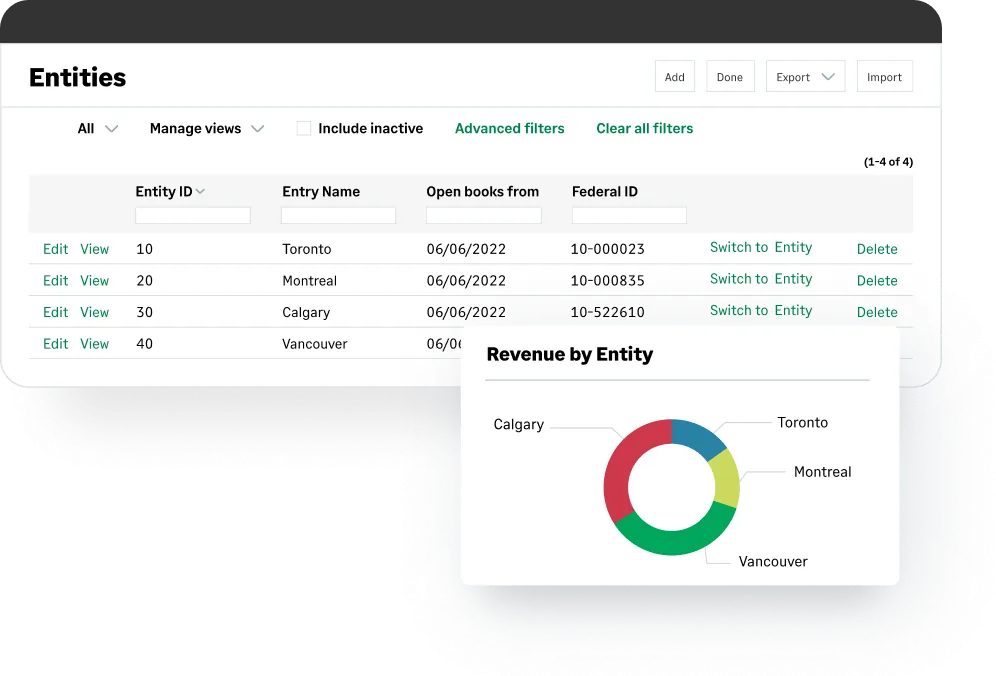
Day to day that is a switch at the top of the screen. A controller works inside one entity, moves to the group view without exporting anything, and the balance sheet reconciles because it is the same data at a different level. Intercompany transactions post to both sides against configured due-to and due-from accounts rather than being remembered and journalled at period end.
The implementation work here concentrates in three places and none of them is technical. Deciding your entity structure honestly, including whether every entity you carry still needs to exist. Agreeing the intercompany policy, which is often where a group discovers two subsidiaries have been settling between themselves informally. And setting ownership percentages and elimination rules with your auditor in the room, before go-live rather than after the first group report is questioned. The broader case is in our article on consolidating finances for multi-entity organizations.
Trusted data, and the reports your team will actually run
Agile, data-driven decisions rest on one unglamorous property: the number in front of the executive is the number in the ledger, with nothing in between. Every figure on a report or dashboard drills to the accounts inside it, then to the individual postings, then to the source document with its approval and attachment.
The standard general ledger reports do most of the daily work: a trial balance that runs by any dimension combination, an account activity view, and the general ledger detail report, which lists every posting behind an account for a period and is normally the first thing an auditor asks for. Those three cover most of what a finance team needs before anything custom gets built. Above them sits the report writer, and our guide to Sage Intacct dashboards and reporting covers how to sequence that work.
What the implementation actually takes
A general ledger implementation is mostly design and data, not configuration. The configuration itself is measured in days. Designing the dimension structure and migrating history set the timeline, and both depend on your team’s availability more than on ours. One sequencing rule matters above the rest: nobody builds reports until the dimension structure has settled.
The migration is where expectations need managing. Open balances and open sub-ledger items come across cleanly. Transaction history is a decision rather than a given. Bringing several years of detail across sounds attractive and produces a ledger full of records with no dimension values, because those values never existed in the source system. The usual answer is opening balances plus a defined period of summarized history, with the old system kept read-only for anything older.
Three patterns account for most of the rescue work we are called into. Dimension design deferred until after go-live, which is the expensive one. A chart of accounts rebuilt exactly as it was, which turns a new ledger into an old ledger on new infrastructure. And nobody named internally as owner of the structure, so the first person who needs a new account creates one and the discipline erodes within two quarters.
The page this post replaces closed with a gated datasheet and a form. A datasheet can tell you the ledger supports dimensions. It cannot tell you which dimensions your business needs, what your history will look like after migration, or how long your team will take to agree an intercompany policy. Those answers decide whether the project goes well, and they come only from a conversation about your actual books.
What changes in your month after go-live
The close gets shorter, and the reporting that follows the close gets shorter by more. Recurring journals, allocations and consolidation steps compress hard. The parts that depend on other people, like getting the last supplier invoices in, barely move. Plan for the first close after go-live to be slower than your old one.
[DATA: Lucentive’s measured close-cycle reduction across recent Sage Intacct general ledger implementations — Rich to confirm]
The second close is usually about even, and the third is where the gain shows. The change people mention months later is not speed, though. It is that the arguments stop. When a department head questions a figure, somebody clicks it in the meeting and the conversation ends there instead of carrying to next month while an analyst reconstructs it. Hear the trade-offs too. Someone now owns the dimension structure and that ownership needs a name against it, data entry gets slightly heavier at the front end because dimensions are applied when a transaction is created, and visibility creates appetite: once leaders trust the numbers, they ask for more of them.
Sage makes the same point through a customer of its own. The page this post replaces carried a quote from the chief executive of one of them, describing a shift from reading the P&L and balance sheet once a month to checking a couple of dashboards every morning. That is a fair description of the behaviour change, and it is worth being clear about whose reference it is.

Summary
The general ledger here is good in a specific way worth understanding before you buy. It is not a modelling tool. It is a well-structured ledger that separates accounts from dimensions, so nearly all of the value depends on structuring it well at the start. Design the dimensions before the data load, cut the chart of accounts back to things that are genuinely accounts, decide the migration cut-off deliberately, and name an internal owner during the project rather than after it.
If you are evaluating now, bring two things to a conversation: your current chart of accounts, and the questions leadership asked last year that took more than an hour to answer. Our consultants will map those questions to a dimension structure and say plainly which are straightforward and which need a process change first. Compare the mechanics against what you have today in our piece on core financials and the month-end close, or start a conversation with our team.
Frequently Asked Questions
What is an intelligent general ledger?
It is Sage’s name for a ledger that combines dimensional tagging with automation over the posting process: templated and recurring journals, rules-based allocations, and outlier detection that flags entries not matching the usual pattern for an account and dimension combination. For a finance team the useful part is that review shifts from reading every entry to reading the ones that look unusual.
How do you use Sage Intacct day to day?
Most finance users work in three places: entering or approving transactions in the sub-ledgers, reviewing dashboards that read live from the ledger, and running reports at period end. The general ledger itself is mostly somewhere you look rather than type, because most postings arrive from accounts payable, accounts receivable and cash management rather than from manual journals.
What are the standard general ledger reports?
Three carry most of the load: the trial balance, which runs by any dimension combination, the account activity view, and the general ledger detail report. The detail report lists every posting behind an account for a chosen period with its source document, and it is normally the first thing an auditor asks for.
Is there a Sage Intacct general ledger API?
Yes. Sage publishes a Web Services API covering the general ledger alongside the other modules, and it is how most integrations post journals, sync dimension values or pull balances into another system. During an implementation the question is rarely whether the API exists and usually which system owns which record. Settle that before anyone writes an integration.
What is the difference between Sage and Sage Intacct?
Sage is the software company. Sage Intacct is one product in its range, a cloud financial management platform aimed at mid-sized organizations, and it differs from Sage 50 or Sage 100 in architecture rather than only in size. The dimensional ledger, native multi-entity consolidation and the reporting layer are what separate it, which is why a migration is a redesign rather than a data copy.
Is this the same as general ledger software for small business?
No, and the distinction matters when you compare options. Entry-level general ledger software, including the free packages that turn up in search results, is built for a single entity with a flat chart of accounts. This platform targets organizations that have outgrown that: multiple entities, several ways of slicing the same revenue, or reporting obligations a flat ledger cannot meet without spreadsheets doing the real work.